
DOWNLOAD THE APP


Customer Services
Copyright © 2025 Desertcart Holdings Limited
DOWNLOAD THE APP
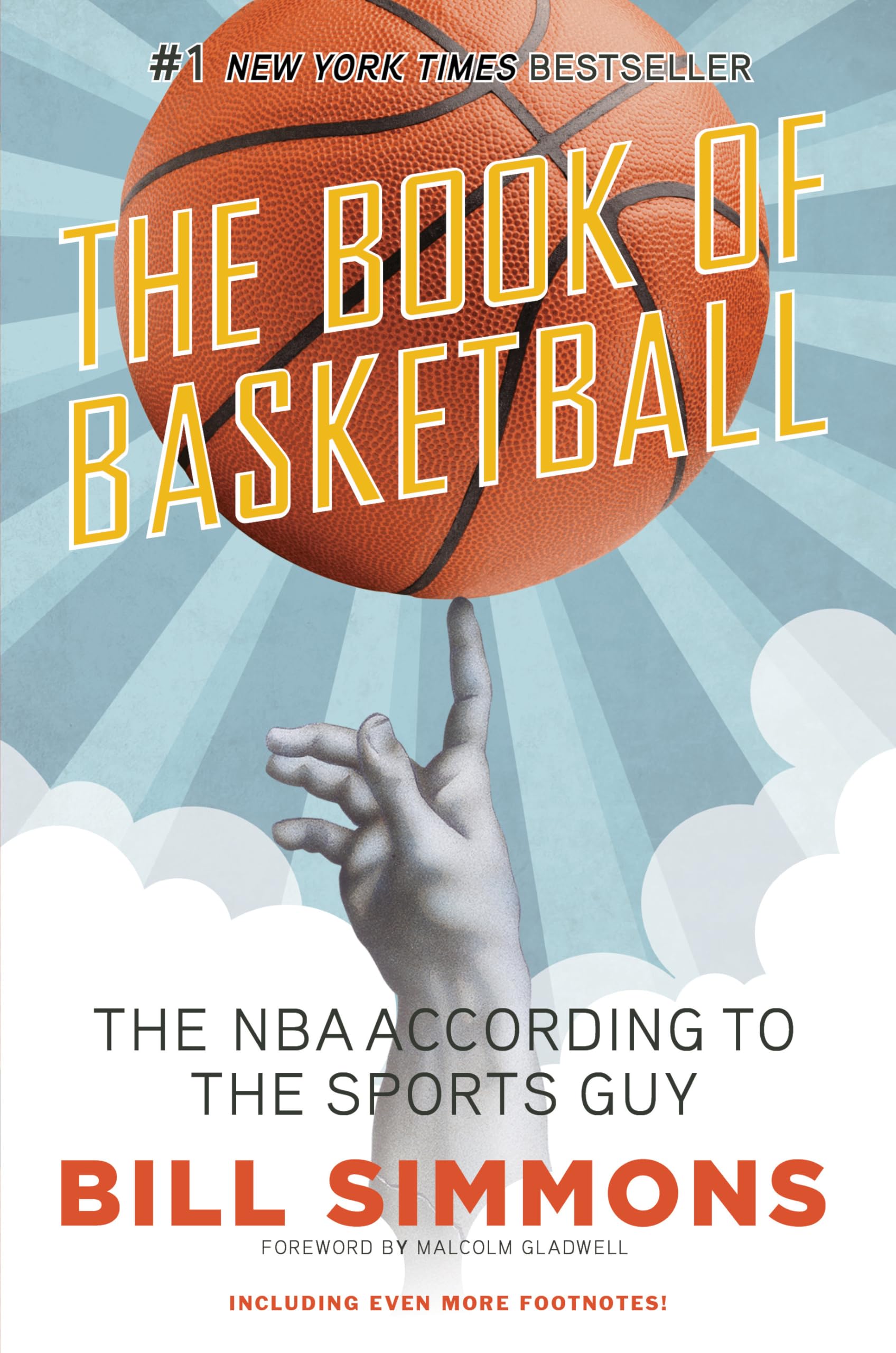
🏀 Unlock the ultimate NBA playbook — where stats meet stories and legends come alive!
The Book of Basketball by Bill Simmons is a 700+ page masterclass blending humor, history, and deep NBA analysis. It challenges traditional stats-based rankings by exploring players’ true impact, cultural context, and the intangible qualities that define greatness. With candid commentary, pop-culture wit, and standalone chapters, it’s a must-read for serious adult NBA fans and Simmons enthusiasts eager to join the ultimate basketball conversation.
| Best Sellers Rank | #51,351 in Books ( See Top 100 in Books ) #16 in Sports Essays (Books) #33 in Sports History (Books) #34 in Basketball (Books) |
| Customer Reviews | 4.7 out of 5 stars 2,054 Reviews |
D**E
The Best book over 700 pages I've ever read.
Before I begin the review, I'd like to point out the valid and invalid criticisms of the book with my responses to them: Valid criticisms: 1) "It's a little too long" (arguably yes, I myself probably could have enjoyed the book just as much if it were 50-100 pages less. I do question though if having less pages would've left out an important area of debate and even after I read this book, I felt there were more topics and issues that could've been presented.) 2) "It is vulgar at times and has too much profanity" (Very valid, this is NOT a book for little kids, this is definitely a book for ADULTS. If anything, adults should read it and boil off the profanity and just give the main points of the book to the kids that want to learn about the NBA. SPOILER: It is important for kids to know why Dennis Johnson was one of the most important players in NBA history; it is perhaps not important for kids to know how large his "equipment" was). 3) "It is borderline racist" (this one is rather suspect because Simmons, to the best of my knowledge, is not a racist and is actually quite brave to tackle race in his basketball book. No serious book about the history of professional basketball can avoid racial questions and when Simmons is being serious, he does a superb job of tackling race and racism in professional basketball. That being stated, it is not out of the question that some readers with antennae turned to high would be offended, especially when Simmons is trying to be funny. However, I suggest you read what he writes about Oscar Robertson and Elgin Baylor before judging him.) SPOILER: Bill is quite "racist" against one race, the Martians. He just assumes that the Earthlings would roll over a Martian Dream Team. 4) "It is too much in the Simmons wheelhouse" (Valid too, I have been a fan of the Simmons columns and podcasts and therefore I get a lot of the humor and his style. However, perhaps someone born after 1992 or before 1958 won't get a lot of the humor and therefore feel lost as Simmons rattles off pop-culture references and jokes that resonate with people that grew up around his time. Also, people not familiar with his columns may also feel lost. Some might consider this book, because of Simmons' comedic perspective, a book with a specific audience. However, if you can get past the pop-culture references, you may still find that this basketball book is one that you can appreciate even if you don't get all the jokes.). 5) "I don't like the NBA and/or I know nothing about the NBA" (Sorry to hear that. This is not an NBA book for novices in terms of the debates it wants to start and in terms of the questions it asks. Simmons' passion for the sport might alienate the person that is new to the NBA or just hates it. I've been a NBA fan for over 25 years and even I got an education from reading Simmons so imagine what the newbie/hater would have to face.) Invalid criticisms: 1) "It is way too long!" (What are you 8? In this case, read response to valid criticism #2. Simmons is attempting to discuss the entire history of the NBA and quite frankly, with all the issues involved over the past 60+ years I'm surprised that the book isn't longer. Also, it is not a united 700 pages, rather one could easily read any of the book's 13 chapters as standalone ones. BTW, if you can't read more than 100 pages, then you might want to give up on reading altogether, unless you are the aforementioned 8 year old or lower in which case this book is not for you anyway). 2) "It has a lot of footnotes" (Normally I would respond, but I think giving you a pacifier would be better. If you like, don't read the footnotes. You'll get a different interpretation of the book from the rest of us and you may complain about that too but then again, you're the baby whining about the footnotes in the first place). 3) "I hate Bill Simmons" (You most likely won't like the book then. But I have to question the sanity of someone who hates Bill Simmons, then reads a 700+ page book by the same Bill Simmons, then comes on to Amazon to badmouth Simmons and the book [oh wait, this person did not read the book?]) 4) "Bill Simmons is a Boston-homer so most, if not all, of his conclusions are slanted that way" (You can't be more wrong about the book, yes Simmons is a Boston-homer but the majority of his analyses are reasonable given the thesis of the book. Fans of other teams, knowing Simmons' Boston-homer demeanor, should be pleasantly surprised by many of the analyses and conclusions he makes) 5) "Bill Simmons pathologically hates Kobe/Kareem/Vince Carter therefore a lot of this book will be anti-those guys" (see response to invalid criticism #4). Now my review: "The Book of Basketball" by Bill Simmons is to me the right combination of comedy book, sports chronicle and master's thesis (if they have those for NBA analyses). It is because of this that even though the book is over 700 pages long, it is not boring because while reading it, it at times can make you laugh, make you think, make you feel, or some combination of the three. The basic premise of "The Book of Basketball" is that one should not judge players solely on the stats. One needs to go beyond the stats into who these players actually are/were and what their peers thought of them in order to determine their overall value to the history of the sport. It is quite an ambitious undertaking and one that requires a thorough examination of the sport and all its leagues and eras. Simmons utilizes all of his firsthand knowledge of watching games, tapes of old games, interviews he did himself, and a collection of great basketball books and condenses them into a book that explores every era, every league and every relevant player and issue. Simmons brilliantly opens the book with a chronicle of a conversation he had with Isiah Thomas (a guy Simmons attacked in many-a-column) and closes it with a chronicle of a conversation he had with Bill Walton. These two bookending chronicles set up the rest of the book and how one should value players and teams. What Isiah calls "The Secret" and what Walton calls "The Choice" is that intangible quality that makes an NBA player and a team successful. Armed with the concept of "The Secret" (or "The Choice"), Simmons examines and sometimes reexamines those players and teams that grasped this concept and those that didn't and used this as a variable to determine the greatness of that player or that team. Simmons reexamines the "Russell versus Wilt" debate and creates the "Hall of Fame Pyramid" where players are placed on different tiers depending on where their play ranks in the overall importance of the history of the league. In addition, Simmons poses the great "What Ifs?" of NBA history (which, as a fan of Cowley's "What If?" books for history was a welcome surprise for yours truly), looks at the greatest single-season teams from a different viewpoint and looks at specific individual player seasons that you would want in the NBA "Wine Cellar". Without creating separate chapters, Simmons also examines the spread of cocaine in the NBA during the late 70s to late 80s, the personality traits/flaws of certain players and the role that race and racism played in the history of the NBA. The best thing about this book is that it is as Malcolm Gladwell wrote in the foreward: "This book is supposed to start arguments" and after reading it, this book can and should generate a few healthy NBA debates. In addition, he gets guest input from "luminaries" like William Goldman (a 40+ yr Knicks season ticket holder/very successful screenwriter) and Chuck Klosterman (a confirmed sports atheist/writer). Simmons also injects a lot of comedy (I mean a lot). For those unfamiliar with Simmons' columns and podcasts, Simmons combines analyses and personal stories in this book with many humorous pop-culture references to Hoosiers, Teen Wolf (in a very surprising way), Scarface, the Wire, Mad Men, Shawshank Redemption, the Godfather and many well known and lesser known ones (the references to porn are why this book is not for kids). So who is this book for primarily? 1) any serious (adult) fan of the NBA and/or 2) any fan of Simmons' columns/podcasts. If you don't like this book, it is probably because you don't fit in either camp. All I can state after that is thank you Bill Simmons for writing this book. It is well overdue.
A**N
Simmons at his natural best.
Buy this book if you like Simmons (he's uncensored! and he curses!). And even if you don't, buy this book if you love sports, basketball, and compelling stories. I had no idea what to expect from The Book of Basketball, except that it was long, and that Simmons has a penchant for long titles (compare "The Book of Basketball: The NBA According to The Sports Guy" with "Now I Can Die in Peace: How the Sports Guy Found Salvation Thanks to the World Champion Red Sox"). On second thought, I suppose those two points are one and the same. Bill Simmons likes words. I'm a Bill Simmons fan and basketball happens to be my favorite sport, so this book was perfectly tailored for me (thanks Bill!). I gotta admit I was a little put off by the length (like Gladwell mentions, I don't think I've read a book this long since... Tolkein), but I guess I'm used to reading his long two-part, thousands-word columns and listening to his two-part, hours-long podcasts. I have no idea how long an Olympic sports argument with Chuck Klosterman would look like in print, but that's exactly how The Book of Basketball reads--conversational, insightful, and funny. The extended length fits in really well for its added humor and context. Unlike Simmons's previous work, "Now I Can Die in Peace: HtSGFSTttWCRS", The Book of Basketball isn't very homer at all, with only occasional (okay, frequent) digs at Kareem, and praises of Larry Bird. Now I Can Die in Peace suffered from an interrupted flow from essay to essay (and my hatred of the Red Sox--go Angels!), but The Book of Basketball flows very well throughout, with its foreword leading up to the prologue and intro chapter to start off Simmons's journey into discovering and breaking down the philosophies and secrets behind basketball. And that's what I was really pleased about. I'm not sure if I agree with Bill's quote about being able to finish The Book of Basketball in 15-minute chunks on the toilet--the sections are pretty heavily broken down (I realized this after the initial shock of seeing 700 pages structured into 15 sections), but I find myself plodding on to find out where Kobe stands in the Pyramid, what really happened in Vegas between Bill and Isiah, and Magic's seven incarnations. It's hard to put this book down when you've just finished an essay detailing the introduction of the three point line, and the next essay's title is so enticing (1980-81: Nose Candy). If you're one of the millions of [...] readers that enjoy Simmons's work, I have no doubt that you'll love The Book of Basketball. If you're a fan of the NBA, and have no idea who Bill Simmons is (do you guys exist?), I'd still give it a wholehearted recommendation. The Book of Basketball is enjoyably comprehensive, funny, and interesting, and one of Simmons's best works (along with his Spelling Bee diary and Leitch roast).
R**Y
Maybe the greatest book on the NBA...EVER!
Last year I purchased Bill Simmons' The Book of Basketball for my birthday. Wow I didn't know what I was getting into. The book was released in 2009. I picked up the soft cover of the book which is the one I suggest everyone pick up. He has updated the book over the years only adding to how good it is. This book is 700 pages long so be ready for a long read. While it is an easy read for big fans of the NBA it may not be for the casual fan. If you aren't a fan who loves reading about the past in great detail this book may not be for you. Me? I am a big NBA fan and do love its past. I will preface everything by saying Bill Simmons isn't perfect but he is a fan, a passionate fan, who has used this medium to put down his thoughts on the sport he loves. And he did a great job in doing so. Simmons is a Celtic homer. No doubts there. And while it may make you wrinkle your nose at some of his thoughts he is still pretty centered and doesn't go too far left. Since he grew up going to Celtics games in his youth there is plenty of Celtic love in this book and some Laker hating as well. Do not let this cloud your thoughts about reading this book. Simmons did tons of research including reading a library of books on the NBA as well as tons of video research to ensure his writing was as accurate as his memory. I want to say it took him three years to write the book. I can't say enough about how much I enjoyed it. His perspective is a great easy read and he loves having fun with his words. Simmons also has a love for the footnote. Almost every page has at least one. His humor can also be on the adult side at times. Not that an eleven year-old is going to pick up this book but I just wanted to mention it. I didn't start following the NBA until around the time I was eight or nine. My brother-in-law Curtis got me into playing an NBA board game (Statis Pro Basketball) in the 70's and I was hooked. Weird how a board game can get someone hooked on sport such as basketball. Go figure. It was perfect timing for me as the Larry Bird - Magic Johnson era kicked in at the same time and I've never looked back. I love history and learning more about things I enjoy. This book was perfect me. I wish there had been a little more love for my favorite Dominique Wilkins and the Atlanta Hawks but I was still very happy with his thoughts on both. We all look at sports in our own unique way. I am 43 now and how I viewed and learned the sport of basketball 30 plus years ago is much different in how I learn and view it now. To that end I loved Bill Simmons' insight into the game. To quote Paul Harvey this book gave me "the rest of the story". While I could always see the play on the court I didn't have the basketball/NBA smarts to dissect some of the details. There was little NBA coverage at that time in small town America and until the NBA hit cable it was just as hard to see games consistently. This book provides tons of insight I never had. Nowadays every move is over analyzed instantly on TV and on the web allowing us to make a better informed analysis of what we are seeing in a game and around the league. It just wasn't that way back in the day. So as Bill Simmons looks at the NBA from every possible angle I was able to live those early days of watching the NBA all over again. This time with a new appreciation. This is a must read for any NBA fan. Again it may be a bit much for the casual fan but if you think there is any possibility you might like this book I suggest you spend the $11.11 on Amazon or at some other retailer and I don't think you'll be disappointed.
M**D
Vintage Simmons, for better or for worse
I'll preface this review by saying that I have been a big Bill Simmons fan for years, and that I enjoy his prose: an irreverent, from-the-hip, funny yet knowledgeable take on sports, more often than not infused with a healthy dose of pop culture. If you've never read Simmons before, this book may come as a bit of a shock- it doesn't have the same sententious, pretentious and solemn tone that most sports works have. Simmons' style is more colloquial, subjective and unapologetic. Bill Simmons is a life-long Celtics fan, as his readers know, and yes, this book is at times guilty of favoritism towards the Celts. In his defense, however, Simmons goes out of his way to look at both sides in most cases, and his treatment of Russell vs. Chamberlain is probably the most level-headed, smartest part this book. This volume is long, yes, and it is also chock-full of footnotes. The notes are almost always amusing or interesting, though their constant use (they are on every page, or so it seems) does give the book an at-times manic, full-of-caffeine feel. I didn't mind them at all, but that's just me. So what are the pros and cons? Pros: this is a book written by a fan, for fans. Don't get me wrong- it is clear that Simmons worked his butt off to research and write this volume, and he gets his facts straight. What makes it different is that it doesn't pretend to be a "definitive" account of anything - just his own obsessive, entertaining take on the game he loves. Who hasn't spent hours comparing or arguing about the greatest teams and players of all time? Reading Simmons feels like have a heated but friendly argument with a buddy over beers. It's fun, it's memorable, and of course sometimes you will disagree. One reviewer took Simmons to task for not having any credentials to write this, since he doesnt/hasn't played in the NBA. That's the point of this book! It's not another inane, mumbled biography by a washed-up athlete, but a coherent, fervent essay on basketball by a fan - blogger - journalist. The cons of this work? It lacks a bit of coherence. The first part chronicles the origins of his love for the game, then he narrates the history of the league (informative and very candid), the "secret" of basketball (teamwork, duh), then most of the book is devoted to ranking the best players and teams of all time. There is no real narrative, thesis statement, argument, etc. I feel like Bill's rankings could have been a companion book in themselves, since the type of narrative is very different from the rest of the book. My other pet peeve with this book is that in his arguments, sometimes Simmons will validate his point with a gross (mis)generalization about an era's style of play. Such as when he describes Stockton and says that his assist numbers are inflated, because Stockton played in an age "when it was easier to get assists." That's it, no explanation or statistical back-up. Simmons does this a number of times, often generalizing about his opinion about the ease with which rebounds, assists, etc were obtained. It feels like a cheap bar argument, especially considering how much of a stat nut he is in other parts. Overall, I really enjoyed this book. Simmons fans will love it, and open-minded sports fans will discover a fun, engaging author. Recommended.
A**E
The NBA is Faaaannnntastic!
Bill Simmons takes an NBA fan on a journey through decades and decades of information, analysis, stories and relevance of all that has transpired in our beloved NBA. All intertwined with pop culture references, great humor and excellent factual information. His Bill Walton- Tupac story is one of the best at blending two people who seem as different as you can get, yet the comparisons totally make sense. Also hands down the best breakdown in a Russell-Chamberlain argument. The books theme is to explain to us why certain teams, players and moments mattered for the NBA to arrive at it's current point. It's a mix of Bill's ESPN column with a little Malcolm Gladwell's "The Tipping Point" (he writes the forward to the book) mixed in with some really great old school pop culture references that are genius. Bill covers all of this in his own way and it is one of the many reasons it's really a brilliant book. Ever wonder why Dr.J went to the Nets and not the Knicks after the merger, covered. As a Knicks fan, yeah I know, as a Knicks fan I was surprised that was something I had not known about. His take on a new Basketball Hall of Fame is hysterical and really bright and interesting at the same time. I hope David Stern reads and considers "The Pyramid". Bill's player ratings and overviews are really the heart of the book and it's why the book is a 5 star read. Excellent analysis here. As a rabid NBA fan myself he really nailed this part of the book. We may not all agree with his rankings but he makes a good case for it with information and numbers to back up his claim. The historical information in The Book of Basketball is remarkable. Bill Simmons can save you hundreds of dollars alone here. He pretty much gives you information that a shelf of books doesn't hold. Having read most of the books he used as reference I can tell you that Bill was on cue in his take on the league and it's stars. The size of the book is a plus once you get it into it, so don't let that discourage you. Buy this book, it really is the definitive NBA book. Hey Bill if you ever read this, I just want to say thanks for writing The Book of Basketball. It reminds us that the NBA is Faaaaantastic!
I**H
Classic Simmons!
Awesome read — 730 pages of classic Simmons insights and opinions!
S**E
Unique and comprehensive
The writing style will certainly be familiar to regular readers of Simmons' articles. Some may find the cultural references too cutesy or forced ( or inappropriate for some), but the vast majority of the time I find them quite funny. I am the same age as Simmons so perhaps they resonate more with me than some others. Regardless, the quality of the basketball analysis is outstanding and is worth a read even if you skip past all the references. I found the "How the Hell Did We Get Here" chapter especially elucidating, a fantastic description of the various eras. He writes explicitly of the important but usually avoided topics such as race and drug use and how they affected certain eras. He is willing to tell insider's stories even though his basic premise has always been writing from the fan's perspective. I have never liked the Celtics but am entertained and amused by his Celtic stories and unlike other readers do not feel like his rankings are overly biased. I am a lifelong Pacers (and therefore Reggie Miller) fan, and believe his evaluation of Reggie's strengths and weaknesses are spot-on and fair , despite his labeling of Reg as the most overrated "superstar" in the last 30 years. A potential complaint might be that although he emphasizes that the Secret of Basketball is achieved when players willingly ignore statistical goals for the betterment of the team, the book at times gives overwhelming statistical analysis. The beauty, however, is that the book is divided into many short segments which can be read at different times and order, if one gets exhausted. I bought this book for my 15 year old basketball player/fan (knowing that I also wanted to read it) so that he could get a better grasp of names and teams from the past. I believe Simmons did a fantastic job of creating an extremely lively and fair appraisal of the important players and teams in the modern times of pro basketball. I highly recommend it to anyone who enjoys pro basketball. By the way , I am one of the seemingly few fans who prefers the pro game to college, especially playoff basketball. Perhaps this book will encourage some people who dismiss the NBA to see what they are missing.
B**L
For fans of Bill Simmons
I've been a fan of Bill Simmons since my college friends introduced me to his Boston Sports Guy website in 2000. Like so many of his fans, I've read every column he's released since that point - he has an easy going and informative writing style which has appealed to so many people. So for fans of his work - I recommend this book whole-heartedly. I believe Simmons wrote this with the goal of doing the best work of his career, and he left nothing on the table. The breakdowns, stories and rankings are all amazingly thought out, and while he may make points that you might disagree with, they are never unsubstantiated. For those who aren't familiar with Simmons' work: a few notes. First, he is an unabashed homer for all Boston sports teams, and this bleeds through everything he writes. So if you are expecting an unbiased look at the sport of basketball, look elsewhere. Second, his writing builds over time with inside jokes, references to previous columns, etc. It's impossible for me to say how this would translate to a reader unfamiliar with all of his Simmons-isms, but I doubt it would improve the reading experience. Third, while there is some structure to the book, most notably in the ranking of the 96 (not an arbitrarily chosen number, by the way) greatest players of time, there are several sections that are just there so Simmons can write detailed chapters expounding on his basketball thoughts (what-ifs, building a perfect team, etc.). It's all really great stuff, but has the feel of a collection of essays as opposed to one cohesive book. Finally, Simmons frequently inserts pop culture references into his writing. As other reviewers have noted these can and will become dated with time. We'll see how the book ages. None of the above is meant to scare off the uninitiated - he's a terrific writer, and certainly one of the absolute best current sports writers around. It just helps to know what you are getting into.
Trustpilot
3 weeks ago
3 days ago