
DOWNLOAD THE APP


Customer Services
Copyright © 2025 Desertcart Holdings Limited
DOWNLOAD THE APP

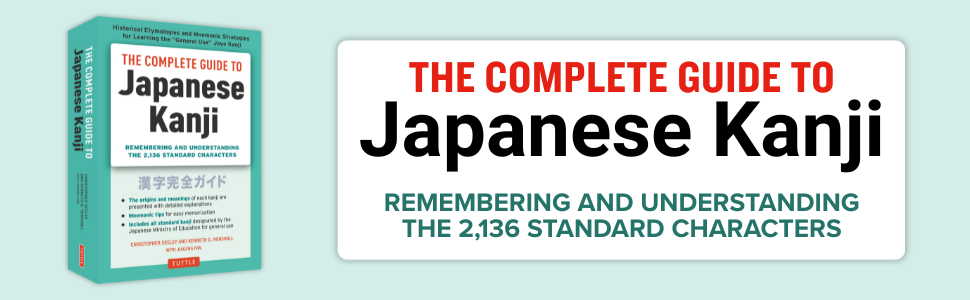
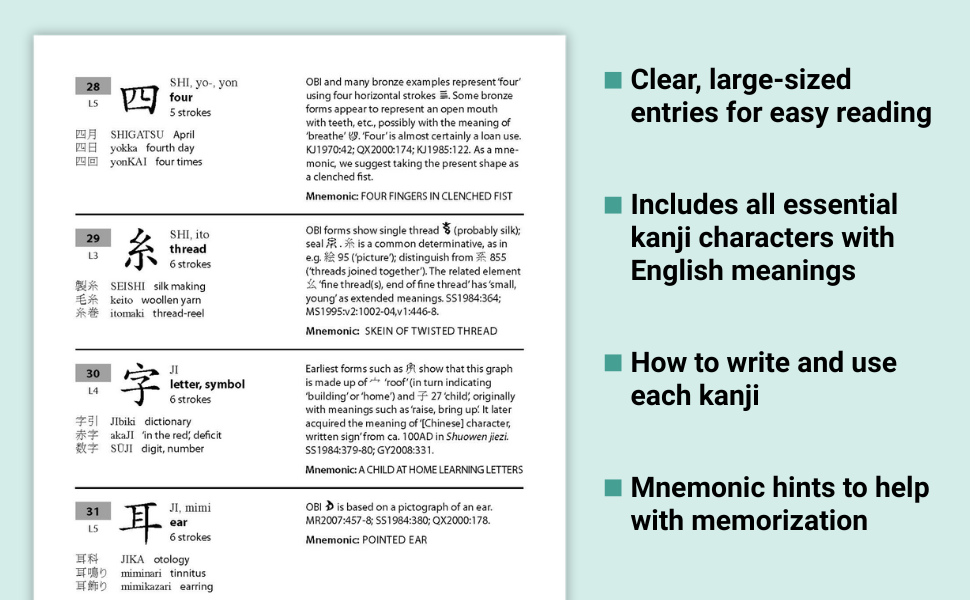
desertcart.com: The Complete Guide to Japanese Kanji: (JLPT All Levels) Remembering and Understanding the 2,136 Standard Characters: 9784805311707: Seely, Christopher, Henshall, Kenneth G.: Books Review: A Wonderful Reference Tool- and Great Fun As Well ! - My Japanese is VERY limited and it is quite daunting to learn, though way easier than Mandarin, having a fine book like this does a lot to spark my interest. Tuttle's Complete Guide To Japanese Kanji is a comprehensive book of essential Japanese characters including a limited chart of katakana and hiragana, but really more focused on the Kanji, complete with history, etymology, stroke order, word usage and mnemonic tricks. Filled with tons of information, this is completely fascinating, also lots of fun to read and is one of my favourite Japanese books. Not a dictionary but more of a catalogue of Kanji, so having a Japanese dictionary as well is necessary- luckily, Tuttle's Concise Japanese Dictionary is excellent. I am very impressed by Tuttle's Japanese and Chinese books, and also recommend the similar Reading and Writing Chinese for Mandarin, if you have both you'll see the Chinese roots of many Japanese characters. Also recommended their Japanese Stories and Japanese Folklore For Language Learners, a bit advanced, but a fine set of simply told traditional tales in bilingual format with vocabulary and cultural word lists. Review: Great for those who love etymology - I absolutely love knowing the origin of words, and this book does a great job of explaining how the kanji came to be and the best ways to remember it. Considering there are a lot of kanji to cover, I like how well-organized and easy to read it is. However, I would use this more like a study tool rather than translations as it can be hard to find the word/kanji you're looking for quickly. There's a glossary in the back to help make finding them a bit easier, but not enough for on-the-fly translations, like if you were trying to read a poster in a store. Lastly, for those who are mindful of JLPT levels, this book is great as all the kanji are labeled and organized by their JLPT level.
| Best Sellers Rank | #668,374 in Books ( See Top 100 in Books ) #316 in Alphabet Reference #566 in Vocabulary Books #1,169 in Foreign Dictionaries & Thesauruses |
| Customer Reviews | 4.7 4.7 out of 5 stars (466) |
| Dimensions | 6 x 1.4 x 9 inches |
| Edition | Bilingual |
| ISBN-10 | 4805311703 |
| ISBN-13 | 978-4805311707 |
| Item Weight | 2.31 pounds |
| Language | English |
| Print length | 704 pages |
| Publication date | March 22, 2016 |
| Publisher | Tuttle Publishing |
A**Y
A Wonderful Reference Tool- and Great Fun As Well !
My Japanese is VERY limited and it is quite daunting to learn, though way easier than Mandarin, having a fine book like this does a lot to spark my interest. Tuttle's Complete Guide To Japanese Kanji is a comprehensive book of essential Japanese characters including a limited chart of katakana and hiragana, but really more focused on the Kanji, complete with history, etymology, stroke order, word usage and mnemonic tricks. Filled with tons of information, this is completely fascinating, also lots of fun to read and is one of my favourite Japanese books. Not a dictionary but more of a catalogue of Kanji, so having a Japanese dictionary as well is necessary- luckily, Tuttle's Concise Japanese Dictionary is excellent. I am very impressed by Tuttle's Japanese and Chinese books, and also recommend the similar Reading and Writing Chinese for Mandarin, if you have both you'll see the Chinese roots of many Japanese characters. Also recommended their Japanese Stories and Japanese Folklore For Language Learners, a bit advanced, but a fine set of simply told traditional tales in bilingual format with vocabulary and cultural word lists.
A**R
Great for those who love etymology
I absolutely love knowing the origin of words, and this book does a great job of explaining how the kanji came to be and the best ways to remember it. Considering there are a lot of kanji to cover, I like how well-organized and easy to read it is. However, I would use this more like a study tool rather than translations as it can be hard to find the word/kanji you're looking for quickly. There's a glossary in the back to help make finding them a bit easier, but not enough for on-the-fly translations, like if you were trying to read a poster in a store. Lastly, for those who are mindful of JLPT levels, this book is great as all the kanji are labeled and organized by their JLPT level.
A**R
Great book for kanji etymologies
This book summarizes the origins of all 2136 Joyo Kanji required for learning Japanese. It also provides a short mnemonic for each character. The consensus of advice I got was to use this book as a supplement to the Kodansha Kanji Learner’s Course, which has a better learning order and mnemonic system but doesn’t have much information about etymologies. KKLC organizes all the Joyo Kanji in a logical learning order with an efficient system for remembering each kanji and its main vocabulary, while this book gives you thorough background information that adds another dimension to your learning. With these two books for kanji, plus a good textbook like Nakama, plus Rikai-kun/chan/sama, the Makino grammar books and some kind of reading material, you are in good shape to teach yourself how to read Japanese. You can’t really teach yourself kanji from this book by itself, because you would learn the characters in a mostly random order with no blueprint. Also the mnemonics are not always very helpful, and don’t add up to a structured and consistent system (this is where KKLC is in a class by itself). Still, I like that the mnemonics in this book provide a different perspective, with some useful insights that KKLC doesn’t have. Some people might find the etymologies a bit too much, since they go into discussions of different academic interpretations of where a character came from and how it developed over time. Personally I like having access to this information, even if it’s mostly just for curiosity. Although most of the etymologies are not easy to apply for mnemonic purposes, many of them are interesting in themselves. Also they can be very helpful for understanding the nuances of a kanji, which you can't get from a dictionary. The etymologies cram in a lot of information and citations, but they’re written in a compact style, as are the mnemonics. I like how neither talks down to you or wastes your time with silly nonsense or cuteness. To get the most value out of this book, use it as a reference book rather than as a textbook. Be purposeful in drawing out the information that helps you, and ignore the rest.
D**S
すごい
I think it’s a wonderful book. Just wish there’s a step by step guide on how to write each kanji. Other then that it has ways to rember each kanji and the definition or meaning of each character.
G**A
Quite nice update to the original book
Quite nice update to the original book. Positive changes - first section has the 1006 educational characters in its superior pedagogical order to the previous 996; characters are shown in clear large print which is much easier to discriminate than the previous brush strokes; all 2136 new kanji are included of course; JLPT levels are marked, however they had to arbitrarily decide if a character is L2 or L3, also all characters other than L2-L5 are marked L1, what else could you do although in the older rankings 26 rare kanji were properly left out of the listings, ex #1731 (CHIN) now has an L1 listing whereas previously properly left out; mixed ON-kun kanji examples are printed caps/small for components which is nice (ex #1187) unlike before. The etymologies have undergone a lot of rewrite with sources cited. Sometimes this is really helpful. As an example #1234 KIN meaning "fungus, bacteria". I slightly prefer O'Neill's "fungus, germ" but not bad. In the etymology, it is clearly shown that the character originally meant mushroom and fungus (Shirakawa and Shuowen). Try reading the etymology and the character springs alive! (note the crowding concept in the character). Often it is more useful than the mnemonic given. In addition the examples are really good here and throughout the book. Here SAIKIN is bactera (detailed germ) and KINRUI (fungus type) means fungi - excellent. The example compounds in the book are really great with short and accurate definitions. By the way, Kanji Alive (U. of Chicago) online also has really nice mnemonics for all N2-N5 and kyoiku kanji as well as others and are based on DeRoo. Some of those mnemonics are really super.
A**X
Very useful
Lots of detail for each kanji, memorable ways to not forget them as well. Will be going back with the find tool when I learn more.
A**R
It was very difficult to find a book that included all (or at least most) Kanji, as almost all of them were divided into different books, including only 200 Kanji or so each (which comes to being more expensive). So when I found this book, which is relatively new, I had to buy it. The book is divided very nicely and includes a well presented section on each Kanji. It gives the writing of the Kanji, different readings (which is very important), translation of the word in English, a small historical text about the Kanji (as well as a fun way to remember it), and most importantly some examples of words with that Kanji (with another Kanji), so you can familiarise yourself with different mixes of Kanji, or even learn these words as you go, and most importantly see how different readings are used in different words. Each Kanji also has the stroke number, but not the stroke order, which some may find a disadvantage. However, at the beginning, the book has a section on the stroke order in general, such as top to bottom, left to right etc. with examples, so you will not find it difficult to know what the stroke order is in a particular Kanji if you understand the explanation at the beginning. Overall, I am super happy with the book. It is an absolutely amazing book, perfect for those trying to learn Kanji in one source that has everything it needs to have. It's definitely worth your money, as it's going to take a long time to go through it all, but you won't need another source! Highly recommended!
J**L
Muy completo y en partes, aún así le hace falta los Hiragana
S**D
Hatte dieses Buch gekauft, um Kanji von Grund auf (also im etymologischen Kontext) zu lernen. Leider taugt das Buch dazu nur bedingt. Das Hintergrundwissen, das in dem Buch vermittelt wird, ist durchaus interessant und einer der Aspekte, die zur Aufwertung des Werkes führen. Es gibt einen geschichtlichen Abriss über die Entwicklung der chinesischen und japanischen Schrift von den frühesten Anfängen bis heute. Dies wird in den ersten 7 Kapiteln und Kapitel 8 bis 8.2 des Buches abgehandelt. Ab dem Abschnitt "Hiragana and Katakana and Their Source Characters" fängt es an, seltsam zu werden: Anstatt Unicode verwendet der Autor in der Tabelle handgemalte Schriftzeichen, die streckenweise kaum zu lesen sind und offenbar von ungeübter Hand mit dickem Stift geschrieben wurden (Zeichen haben uneinheitliche Größe, sind schief, usw.). Dabei steht nur der englische Name des Kana Zeichens (keine Erklärung für die Kanji in der Tabelle). Die Tabelle der Derivative wird einem ebenfalls ohne weitere Erklärung hin geworfen. Dabei steht nur die englische Bedeutung des Schriftzeichens und ggf. die verkleinerte Form für Komposita. (Hier verwendet der Autor diesmal Unicode, so dass die Zeichen wenigstens lesbar sind). Auf die Strichreihenfolge wird in einem kleinen Kapitel separat eingegangen, für die einzelnen Kanji aber nicht extra aufgeführt. Wenn es dann zum Hauptteil des Buches, den eigentlichen Kanji-Beschreibungen geht, dann wird es erst so richtig ärgerlich: On- und Kun-Lesung werden nur in lateinischer Umschrift (Romaji) angegeben, nicht jedoch in Kana (das darf man sich dann selbst erarbeiten bzw. aus den Fingern saugen). Mnemonische Hinweise erfolgen zwar, aber nur in Textform. Ein Bild wäre evtl. hilfreicher gewesen. Ansonsten sind die Kanji nach den 6 Schuljahren geordnet, und zu jedem Kanji werden etymologische Hinweise gegeben. Leider muss man zum Lernen der Schrift weitere Literatur zu Rate ziehen, da weder Strichführung noch Kana zur On-/Kun-Lesung angegeben sind. Daher von mir nur eine mittelmäßige Bewertung, da das Buch seinem Anspruch "The Complete Guide to Japanese Kanji" nur teilweise gerecht wird.
P**P
This book will be great use to anyone trying to master the kanji. It begins with a concise introduction to the history and development of the characters, and the Japanese language more generally, before getting into the main section. The kanji are divided by grade level, rather than the JLPT levels, so if you're using it for the JLPT you may need to jump around a little while using it. That said I think the grade level is probably a more clear way to study the content, essentially in order of increasing level of complexity. Each kanji's entry includes its readings, English meanings, example words, etymology and a meaning based mnemonic. The etymology is a game changer, bringing clarity to some very divergent meanings of the same character, as well as insights into the origins and culture from where they stem from. My copy is now fairly battered from daily use earlier in my studies, but it still proves to be a useful resource. Along with other popular resources like Heisig's Remembering the Kanji, and a spaced repetition software like Anki, this book will definitely help you overcome the challenge of the kanji, which will yield significant advantages the further you go in your Japanese studies. Highly recommended.
E**E
Va muy bien
Trustpilot
2 weeks ago
3 weeks ago