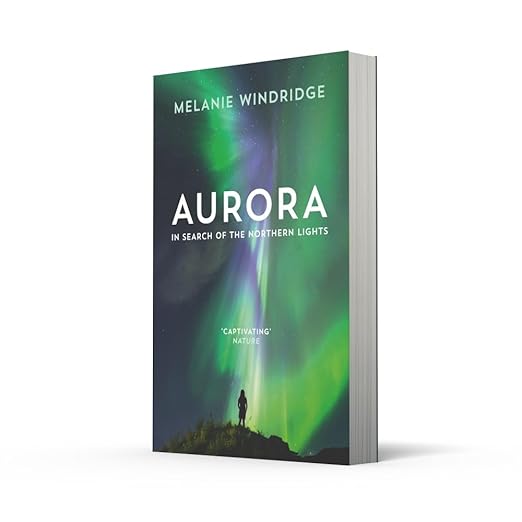


Buy Aurora: In Search of the Northern Lights by Windridge, Dr Melanie online on desertcart.ae at best prices. ✓ Fast and free shipping ✓ free returns ✓ cash on delivery available on eligible purchase. Review: Physicist and adventurer Melanie Windridge recounts her travels to polar regions in search of an understanding of the aurora borealis. Her explanation of the physics behind the aurora is as clear as the arctic sky, understandable to anyone with a high school science education. My paperback edition did not have high-resolution color photos, which would have enhanced my reading experience. The author tells us that our incomplete knowledge of the aurora keeps one of earth’s most captivating phenomena a timeless mystery. Review: Dr Melanie Windridge is a physicist, specialising in fusion research, and an adventurous traveller, at home in the world’s coldest places. These two interests come together in her fascination with the aurora borealis, the Northern Lights, those beautiful, enigmatic, dynamic light displays visible across northern latitudes. (There is an Antarctic equivalent, the Aurora Australis, but this is only visible to a few Antarctic residents) In her book, “Aurora: In search if the Northern Lights”, Melanie visits many places where the aurora is visible – Lapland, Iceland, Canada, northern Scotland, Spitzbergen – and interviews people for whom the lights are a big part of their lives. She travels with Sami herdsmen in northern Norway, and learns of Sami mythology and of the gradual dwindling of their nomadic way of life. In Canada she meets astronomers who run a nationwide auroral monitoring network; in Scotland, RAF pilots who regard the lights as a navigational complication. In between these human interest stories Dr Windridge does a good job of explaining the natural science of the Northern Lights. We now understand that the driving force is winds of charged particles from the Sun, with spectacular displays corresponding to solar flares and coronal mass ejections. But the fine detail is surprisingly complicated and sometimes counter-intuitive. If aurorae are created by particles from the Sun, how come they happen at night, on the far side of the Earth? The answer lies in a subtle series of magnetic field line reconnections, channelling energy from the solar wind into the Earth’s upper atmosphere. It was refreshing to read, at times, that there are aspects of this theory that we still don’t understand. Further diversions take us into the dangers that “space weather” poses for satellites in orbit, and for the power grid down on the Earth’s surface. Melanie mixes these diversions, fascinating and often quite technical, with descriptions of her own efforts to view the aurora. She describes the many aurorae she sees and even has a photo of her best attempts to capture an image of them (with another diversion on how difficult it is to photograph the aurorae and capture the rapidly-changing structure). It’s a pity that she never gets to experience a really jaw-dropping display. However, the book does finish with an astronomical treat. After a week’s skiing in the icy wilderness of Spitzbergen, she ends up in Longyearbyen, Svalbard, just in time to see the majestic total eclipse of the Sun in March 2015. (Disclosure – I was also in Longyearbyen for the very same eclipse, although I never bumped into Melanie) If you are after a coffee-table book full of pretty pictures of the Northern Lights, this isn’t quite the book for you, even though there are colour plates to accompany the text. But if you want a powerful insight into just what causes these extraordinary phenomena, and how they thread through the lives of those who live in the far north, this book comes highly recommended.


D**F
Physicist and adventurer Melanie Windridge recounts her travels to polar regions in search of an understanding of the aurora borealis. Her explanation of the physics behind the aurora is as clear as the arctic sky, understandable to anyone with a high school science education. My paperback edition did not have high-resolution color photos, which would have enhanced my reading experience. The author tells us that our incomplete knowledge of the aurora keeps one of earth’s most captivating phenomena a timeless mystery.
M**F
Dr Melanie Windridge is a physicist, specialising in fusion research, and an adventurous traveller, at home in the world’s coldest places. These two interests come together in her fascination with the aurora borealis, the Northern Lights, those beautiful, enigmatic, dynamic light displays visible across northern latitudes. (There is an Antarctic equivalent, the Aurora Australis, but this is only visible to a few Antarctic residents) In her book, “Aurora: In search if the Northern Lights”, Melanie visits many places where the aurora is visible – Lapland, Iceland, Canada, northern Scotland, Spitzbergen – and interviews people for whom the lights are a big part of their lives. She travels with Sami herdsmen in northern Norway, and learns of Sami mythology and of the gradual dwindling of their nomadic way of life. In Canada she meets astronomers who run a nationwide auroral monitoring network; in Scotland, RAF pilots who regard the lights as a navigational complication. In between these human interest stories Dr Windridge does a good job of explaining the natural science of the Northern Lights. We now understand that the driving force is winds of charged particles from the Sun, with spectacular displays corresponding to solar flares and coronal mass ejections. But the fine detail is surprisingly complicated and sometimes counter-intuitive. If aurorae are created by particles from the Sun, how come they happen at night, on the far side of the Earth? The answer lies in a subtle series of magnetic field line reconnections, channelling energy from the solar wind into the Earth’s upper atmosphere. It was refreshing to read, at times, that there are aspects of this theory that we still don’t understand. Further diversions take us into the dangers that “space weather” poses for satellites in orbit, and for the power grid down on the Earth’s surface. Melanie mixes these diversions, fascinating and often quite technical, with descriptions of her own efforts to view the aurora. She describes the many aurorae she sees and even has a photo of her best attempts to capture an image of them (with another diversion on how difficult it is to photograph the aurorae and capture the rapidly-changing structure). It’s a pity that she never gets to experience a really jaw-dropping display. However, the book does finish with an astronomical treat. After a week’s skiing in the icy wilderness of Spitzbergen, she ends up in Longyearbyen, Svalbard, just in time to see the majestic total eclipse of the Sun in March 2015. (Disclosure – I was also in Longyearbyen for the very same eclipse, although I never bumped into Melanie) If you are after a coffee-table book full of pretty pictures of the Northern Lights, this isn’t quite the book for you, even though there are colour plates to accompany the text. But if you want a powerful insight into just what causes these extraordinary phenomena, and how they thread through the lives of those who live in the far north, this book comes highly recommended.
C**N
Stupendo ! Ho in programma un viaggio in Finlandia e capire l'aurora penso che sia un passaggio utilissimo per godermi a pieno la ricerca di questo fenomeno. Scrittura molto leggibile e comprensibile.
K**Y
The author educates and entertains in equal parts. Great read.
M**N
I purchased the hard backed version of this book which I am pleased about as the cover photograph alone is worth keeping in good condition. This book is well written and as a person from a non science background, I found the level of detail and explanations pitched at the right level. It was an interesting and informative read that provided me with more than enough information to help me appreciate the Northern Lights and how very special they are. The book is written in an enthusiastic manner which is in keeping with the allure of the lights themselves. I would have appreciated seeing a few more photographs of the lights themselves, that said, pictures are easy to come by elsewhere whereas the information that is so well presented in this book is very valuable.
Trustpilot
2 days ago
1 month ago