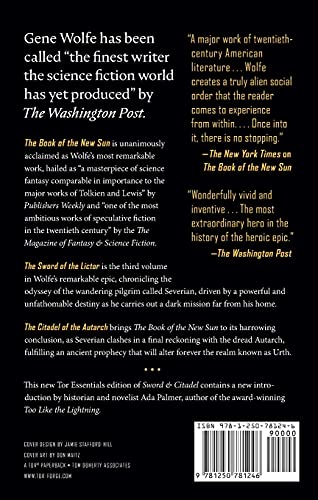
Sword & Citadel (The Book of the New Sun, 2)
J**E
An astonishing accomplishment that demands much from its readers and isn't for everyone
I’ve been thinking now for more than a week about what I want to say about Sword and Citadel, the second half of The Book of the New Sun, and still, I’m struggling to put my thoughts together. That shouldn’t come as much of a surprise; I struggled similarly with the first half of the story, which I both loved and was frustrated by, mainly because I couldn’t quite decide exactly what this strange series was. What I assumed, though, was that I would have more of a handle on the series once I finished it. And that hasn’t quite turned out to be the case. Sword and Citadel – and, indeed, the entire Book of the New Sun, is fairly unclassifiable, a blend of fantasy and science fiction told by an unreliable narrator, a story where almost all of the plotting is done through subtext and implication, where the world being built may be the story, rather than the plot we’re presumably watching unfold.Sword and Citadel follows Severian as he continues on his travels, finally arriving at his designated position as town executioner before once again failing due to an act of undeserved mercy. From there, he wanders the countryside, drifting through a series of encounters ranging from a talking, intelligent beast to a being that might just be a ruler, or even a god, before becoming involved in the war that’s constantly been lurking outside of the boundaries of the series. That’s about all of the story I can really tell you, if we’re being honest; this is not a book whose plot is easy, or maybe even relevant. Rather, it’s about the world being explored, and about how Severian sees and interacts with that world – interactions that are often spiked with cruelty, violence, and judgment.What’s more compelling – and more frustrating – at times is how unreliably Severian narrates his tale. It becomes clear early on that Severian isn’t telling us enough information, through no fault of his own – it’s just that his descriptions don’t account for the fact that we know more information than he does. The description of a knight with a golden visor holding a flag aloft, for instance, is presented as simple fact; nonetheless, as we learn more, it becomes evident that this is no knight, but perhaps an astronaut, holding aloft an American flag. The castles and metal buildings we so often see? Those may be rockets and ships…or perhaps not. But then, as if Severian’s limited perspective isn’t enough, there’s the gradual realization that our narrator quite simply isn’t being straight with us – he withholds, he obfuscates, he distorts, and quite possibly, he lies.All of this comes together in a literary tour-de-force that’s undeniably an intelligent, incredibly-crafted novel. What Wolfe has done boggles the mind; he’s created a world, then filtered that world through an inhabitant trying to describe it, then given that world a spin and perspective that makes it even more unreliable, and then gives this to us in the form of a picaresque journey without clear form and fashion, despite the sense that every single sentence and scene matters. It’s remarkable, brilliant, thoughtful work. And it’s also incredibly difficult, dense, and often frustrating, as you sense that to truly understand this work is going to mean diving deep within its waters, questioning every sentence and every word, and constructing something new from the clues and hints along the way.So do I recommend the series? Yes…and no. To no small degree, what you think of The Book of the New Sun will depend on what you expect out of it. If you expect a straightforward narrative, or a traditional anti-hero, or an epic in the style of Lord of the Rings or Dune, you’ll be frustrated at what you find. This is something wholly else. But if you want something truly – and I hate to use this term, but it’s the only thing that fits – literary, something that displays an astonishing gift of prose and craft, and that you’re willing to work with, you’ll be rewarded for your time and then some.As for myself, I can’t deny that I’m dazzled by the construction and world of New Sun. I’m floored by the scope, and the imagination, and the characters, and the way Wolfe works between layers and layers and layers of artifice. And yet, even now, I’m not sure I truly understand or even come close to getting this book, and that’s frustrating. It’s a series I feel like I need to read a second time, or even a third, to truly get, and I’d be lying if I said that was something I was truly excited about. It’s a series that felt challenging, and it’s all the more so for how deceptively simple it all seems. Is it a remarkable accomplishment, something truly incredible to behold? Undoubtedly. But that doesn’t necessarily make it fun in any sense of the word, or something you’re going to jump into without some thought. Take that as you will.
V**Y
Yes, you should read Book of the New Sun
Just finished reading the first four books. What follows is a first read impression colored by interpretations by Wright and Aramini here and there:Yeah, it's kinda everything you've heard about it: A puzzle, a religious allegory, a masterpiece, a prank. Some of the religious imagery is immediately apparent. For instance, Typhon tempting Severian with world power in exchange for an oath of allegiance comes straight from the gospel when Jesus is tempted by Satan in the desert with a similar bargain. Others are not so obvious. His friends, Drotte, Roche, Eata, Thecla, Dorcas as well as most major characters, Vodalus, Jolenta etc. are all saint names. These as well as the arcane vocabulary are invitations to the reader to read deeply and explore. This is one of Wolfe's main goals--to get you to stop and think about what you're reading. Yes you can enjoy the read not knowing any saints names. But to the beach reader interested only in a lazy summertime read without much engagement, BotNS may leave you unsatisfied. In fact, even with a deep read I'm left wondering to some extent "what the hell did I just read?" Again, this is Wolfe's intent.To dig deep is to embrace the murky. All through the four books I thought, "I don't get (blank--whether "blank" is Baldanders and Talos or the Autarch, or the Sanguinary Field duel) but what I'm reading has a deeper meaning." Severian is clearly a Christ figure. He resurrects the dead, is tempted by a Satan, endures suffering, and by the end of the read clearly is meant to lift humanity up from a cruel existence. But also, by the end, you wonder what is his motivation? Is he a Christ/hero, successful through his own efforts (aided by God), or is he merely a pawn in a game set in motion by aliens with their own goals and motivations making Severian the recipient of good luck instead of rewards through personal effort and Divine Intervention? This flies in the face of Campbellian/Jungian analysis. And this too is a major goal of Wolfe--to break the mold and formula of what we call "good fiction."Campbell illuminated the hero's quest via Jung. And from that we get cookie cutter heroes from Hercules to Luke Skywalker and everyone in between. Wolfe breaks these Jungian rules to the enjoyment of the reader. And this more than anything points to Wolfe's genius. He knows the rules of good writing. And he knows how to break them while keeping us reading and wanting more.I don't pretend to know every allegory and inference Wolfe makes. And this too, I think, is his intent. While the biblical and classical scholar will understand many of them I think he leads the reader down many dead ends. But these dead ends are no disappointment--they are, in fact, new story elements disguised perhaps as writer's pranks. This too is his intent. After all, not every effort a hero makes is successful and rewarded. A hero (and a reader) experiences dead ends too.But are these pranks real, or are they the product of a reader's ignorance to the larger world of literature? Again, this is Wolfe's invitation to deep reading. He invites you to reread and enjoy again perhaps with a deeper understanding this time. As for me, for now, I'll continue on with Urth of the New Sun and further analysis and interpretation of the Solar Cycle. I may come back to Book of the New Sun later. Maybe I'll see something new and Urth shattering.
D**N
One of the greatest Sci Fi tales ever written.
The second half of one of the greatest Sci Fi stories ever told. 👍👍👍👍👍
L**C
Good night.
A single page of Book of the New Sun is worth more than forty years of juvenile attempts by talenetless hacks in constructing what the world at large would call "a fantasy novel." Wolfe is prehaps the only fantasy writer since Tolkien to do it right, the only fantasty writer to have written literature. Good night.
J**Z
It was alright I guess
Brilliant book, I still find myself revisiting it, over a month after I finished it. Lots of stuff going on behind the scenes that you can piece together if you concentrate, extremely rewarding, lucid prose, big bad Wolfe is truly one of the greatest writers alive today.
D**E
Three Stars
good read
M**.
Generally a great book series, poor paper quality in this one
I paid extra money to buy a hardcover book (circa 50% more honestly), and while it's okay and was delivered rather undamaged, it was:- poorly packed (not a single piece of bubble foil or anything else really, just thrown into a cardboard box, both parcels, that's also why some of the paint came off on the corners of the books)- a bit dirty (some sort of stain that I cleaned up with wet towels. It wouldn't come off under finger)/scratched (one of the books has small kind of damage, looks like it was scratched in the warehouse.- the hardcover is indeed "hardcover", but it's not anything special really. I have seen better ones, but fine. It's not something that I can blame amazon for, but the quality of paper is kind of a joke to me (for the price they want).The chapters have ugly headers, but the book looks okay. It's the matter of "style", although I have seen some pretty books...It's printed in the USA (chinese quality though). I wanted the edition written in English, because this is the author's main language, plus I wanted something else than paperback, because they tend to fall apart quite easily...
Trustpilot
1 month ago
1 month ago