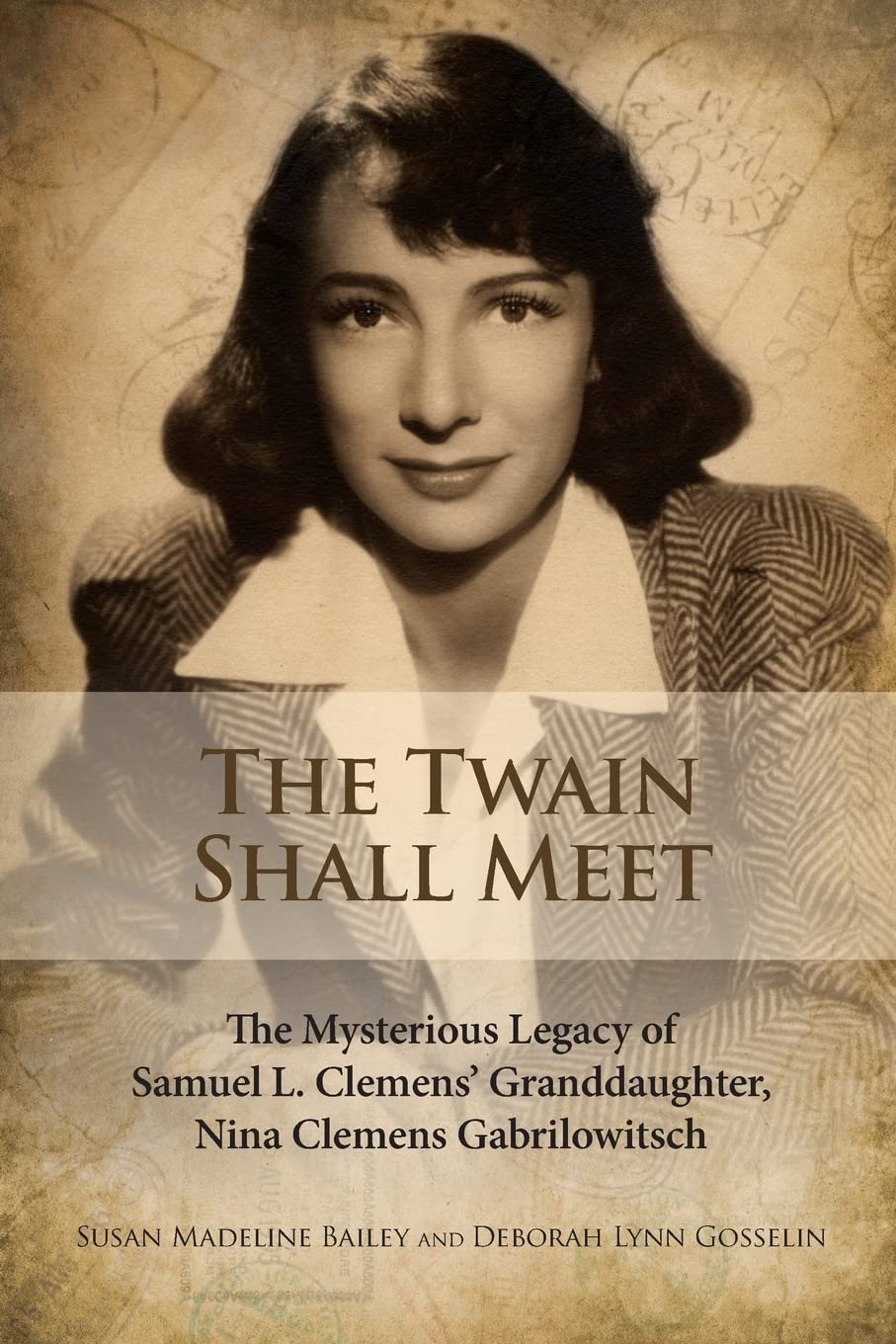
Buy The Twain Shall Meet: The Mysterious Legacy of Samuel L. Clemens' Granddaughter, Nina Clemens Gabrilowitsch by Gosselin, Deborah Lynn, Bailey, Susan Madeline online on desertcart.ae at best prices. ✓ Fast and free shipping ✓ free returns ✓ cash on delivery available on eligible purchase. Review: Mark Twain's granddaughter Nina Gabrilowitsch (1910 - 1966) lived like many women of her era-- sometimes lost, sometimes found. When she died, ". . . her bright mind, mercurial wit, and unflagging devotion to her friends were lost to history,“ wrote Susan Bailey. The story of Nina (Nee'-na) is not forgotten, and there may be a secret baby, born to her, who survives today. As a warm sharing of Nina's life of struggle, loneliness, and glory . . . this book brings insight into the lives of persons and lifestyles from her era. Susan Bailey and co-author Deborah Gosselin both have a personal connection to Twain's family, but aren't yet sure how it fits together. In their book, The Twain Shall Meet, family research ripens into homespun Americana with exotic highlights. In a bolt from the blue, they learn that Nina wrote a diary of her thoughts and conversations with parents, parents’ friends, etc. -- about 1,000 pages! After a period of personal research, Bailey and Gosselin decided to write a book, from their own knowledge plus Nina's diary and hundreds of sources. It's a detective story of genealogical persistence, to spotlight this famous family and their world of persons, all now obscured by time -- and some by their suffering. The authors state bluntly, step by step, their growing theory structure and the doubt, hope, and despair in their research, culminating in a realistic story of Nina Gabrilowitsch which has won a major award. This book has stirred up controversy and new interest, with quietly-told stories that scholars accept as genuine, and a few they're still wondering about. In 1936, the anchor year of the story, Nina Gabrilowitsch's diaries go silent from March 7 to late June. In the early fall of 1936, Nina and her mom Clara (Mark Twain's daughter), skip the funeral of their father and husband after spending his last days with him, together as a loving family. He was Ossip Gabrilowitsch -- Clara Clemens’ husband, conductor of Munich Symphony & later Detroit Symphony -- and he died Sept. 14, 1936. Clara and Nina catch a long train adventure in early October and they seem in a hurry for Europe in late October 1936. Susan Bailey estimates she, herself, was born around January 1937. She has childhood memories of meeting Clara and Nina a few times, and of dreaming in French. The book includes some of those memories. Bailey traces some of her memories to friends & acquaintances of Mark Twain's family-- connections which have been confirmed-- including her co-author's family. So far, the hypothesis is sailing. On the other hand, in her diary, Nina never mentions having a baby. On the other hand, gaps and details give an opening to this possibility. If there was a baby, why doesn’t Nina mention this? This book does a good job of addressing that, in depth. Intuition receives a big nod when facts are still scarce. The search continues for more facts since the book appeared. We see them vetting Nina as a possible Mom -- almost more carefully than we screen possible directors of the CIA. The journey of this book is rich with scenery: names, clues, quotes, memories, & pictures. The authors write with sympathy. Of Nina, Susan writes: “ . . . there were many points in her life that, had she just been given a chance, I believe she could have made it . . . she was destined to choose friends that would ultimately fail her. Maybe that was her big lesson in life -- that she ultimately had no one to depend on but herself. Unfortunately, in the long run, she failed herself!” Such is the prose in this book. Nina died in Hollywood from pills and “drinking, and mood swings, and a profound sense of aloneness . . . " Much of this book is uplifting and wholesome. What is not, is treated in a quest for truth and redemption. It’s dense with stark stories and definite details. The logic feels careful and transparently-assembled through 47 chapters in 338 pages. Susan pursued her connections and the life story of Nina with research for seven years with co-author Deborah Gosselin. Behold: * The life of Nina and her family. * The family trees and entangled friendships which created the puzzle * Susan Bailey's early memories and later life * stories from persons who knew the families * rounds one and two of the DNA tests (they continued after publication) * family resemblances via photos In a few of the later chapters, there are as many new names as pages. Remembering them all would require an amazing memory or a lot of note-taking on a second time through. In one stretch of about 10 pages, we read about these folks: Phyllis Harrington -- caretaker for elderly Clara (Mark Twain's daughter) Jacques Samossoud -- second husband of Clara Dr. Seiler -- a doctor involved with the wills Al Matthews -- attorney for Nina Myron Harpole -- attorney for Nina George Wrentmore -- also Nina mentioned as a husband but probably wasn’t Jules Schmidt -- Nina’s friend who mistakenly thought Wrentmore was borrowing money from Nina . . . and who appeared to be Susan Bailey's father on the first DNA test Susan took! Results stated that she had a 75% DNA connection with two of his biological children. Mollie Schmidt -- ex wife of Jules Schmidt Helen Schmidt -- new wife of Jules Sig Fritschel -- live-in nurse for Nina Pat Gleason -- Nina’s lifelong male friend ‘til very late separation due to neglect Carl Roters -- Nina’s first husband by her account, but probably not -- "we're married" was just an expression Rochelle Vickey -- friend of Nina in later years Olivia Lada-Mocarski -- cousin of Nina George Sobota -- police detective who visited scene and wrote the death report Dr. Laurence Stuppy -- Nina doctor & friend since 1960 Currently, there is no overwhelming consensus about this theory of Nina having a baby, as far as I know. I've talked with Susan Bailey by telephone and message. I've avoided knowing too much of what is "out there" in the world until I read the whole book carefully. I don't know how many other persons, who have strong opinions, have better information or just have joined a telephone game. What are some possible alternatives? Let's wallow in hoaxes for a moment to see how Susan Bailey's claim is different. In 1909, the year Nina was probably conceived, a famous literary hoax was perpetrated when Edmund Lester Pearson posted "The Old Librarian's Almanack." This fooled the New York Times and several other publications. In 1927, Public Libraries magazine called it "a good piece of foolery, bright, clever, with the verisimilitude of authenticity." Pearson was my second cousin, twice removed. In 1922, a woman named Anna Anderson was put forward as Grand Duchess Anastasia of Russia, a miraculous survivor of her family's murder by communist revolutionaries. This didn't fly very well and is a closed case for several reasons. If this book about Mark Twain's granddaughter were fiction purely for entertainment purposes, it would be a closed case. It would still be a good book. Whatever else we say, the authors deepen the Theory of Twain. Several lifetime Twain scholars have been friendly to Deborah Gosselin's and Susan Bailey's findings. And a Mark Twain scholar did a project that finally concludes with opposing the idea that Susan Bailey is a descendant of Mark Twain. David Carkeet suggests Susan Bailey has fallen prey to confirmation bias. His own investigation slips into confirmation bias too. It happens to all of us. David Carkeet's review, "Special Feature, a Report on Susan Bailey's Ancestry," is available at Twainquotes dot com -- Barbara Schmidt's website. His tentative verdict arrives toward the end of his article, along with an expert he trusts about DNA. And the expert, in her turn, trusts the data which was given to her. What could go wrong? Carkeet wrote, "By complete coincidence, sometime in December a new relative suddenly appeared on Susan's match list." Jungian slip? Um. . . he implies there is another way for a new relative to suddenly appear on Susan's match list. He probably remembers the recent DNA unpleasantness during the Amanda Knox case. The scientific ethic must admit there are possible ways the scientific investigation could go wrong ( and any one of these would skew the result ): * sample mix-ups or contamination * reliance on other folks' research without being able to confirm every stage * inadequate budget for tests * blocked access to significant information * over-confidence by experts, in current standards of interpretation-- in other words, the state of the science -- toward providing exactness when interpreting varying results * over-confidence in the experts' ability to produce exactly true interpretations, by the scholars who consult them. * secret agendas by anyone, whether intentional or not & whether motives are discernible or not. Scholarly resistance to Bailey's being Mark Twain's great granddaughter is not, by itself, enough reason to reject that hypothesis. First of all, before this reviewer takes on all opponents, let me be clear about the position I'm taking. I think the book stands on its own merit. Who am I to judge a book or its theories of reality? Am I a creature of ego and vanity, or a universal onlooker? If I am the latter, I need to admit I do not know the final answer, especially if my information is second-hand. We universal onlookers, humble and honest, aren't called to say that someone else is wrong. We can't know that from where we are sitting now. We do know that major DNA lab errors have gone undetected in the past. It's public history. Before examining the "DNA error hypothesis," -- for those conflicting DNA results on different tests -- let's see how Susan Bailey's life fits the pattern. "Bailey came late to her comprehension of how exactly she might be related to the Clemens family, in a twist that she herself had not expected," wrote Taylor Roberts, a Twain scholar. His review is found at the Mark Twain Forum. As a young person, Susan Bailey found mentors who enabled her to find an honest path to excellence. She pays tribute to one of her teachers: “He engaged me in a series of questions that made me think, and he always considered my answers and seemed to find some merit in them.” Almost 30 years ago, Susan Bailey started a children’s musical theater in Tampa that became Class Act Productions. It was adopted by the Hillsborough County Public Schools . . . There have been tremendous successes with the program. In her third marriage, she married Andrew Calliham, former air force pilot and vice president of a bank. Their happy relationship lasted almost 30 years. He died in 2009 --“ . . . in his eyes I could do no wrong,” she remembers appreciatively. "If only Nina had ever learned, as I did, to first love and trust herself before seeking love from a man, she might have gotten to the place of happiness that I reached with my third and final marriage,” writes Bailey. It's a genuine investigation and warm-hearted story. So what conspiracy theory shall we imagine, to help us explain the errors of opposition to Bailey's hypothesis about being Mark Twain's granddaughter, if that is what is needed? For starters, not everyone is comfortable with a wide variety of opinions. In Clara's day, they protected Mark Twain's reputation. It was a time when births out of wedlock were a real scandal, especially among the rich and famous -- so how do we know that someone wouldn't continue to cover up in today's world? Maybe it's about politics: Twain was politically liberal, and conservative. How? In Twain's time, writes Jeffrey A. Tucker, "To be liberal was to favor free enterprise and property rights, oppose slavery, reject old-world caste systems, loathe war, be generally disposed toward free trade and cosmopolitanism, favor the social advance of women, favor technological progress — and to possess a grave skepticism toward government management of anything." (-- "Mark Twain's Radical Liberalism," 2010). Tucker says the meaning of "liberal" was changing as Twain's era was closing. Susan Bailey has been public in her political views. In this age of contentious politics, some opposition might be lurking in less-lit areas. Is there a shadow government which manipulates symbols "for the good of society?" If so, who wants to risk, if they have a choice, granting new influence via the opinion-leading power of being associated with Mark Twain personally? They might justify their adjustment of our reality by reasoning that, in the long run, being related to a person of achievement should not matter as much as the public good. After all, what does it really mean, that someone is a direct descendant of a celebrity or genius? The recombining of DNA in every generation has produced a unique individual. Even twins, while similar, will differ a lot, because each one has sensed and thought and metabolized little bit differently in a million moments through a lifetime. Perhaps they would think there is nothing to gain, and more to risk, by allowing a wild card into the game, if they don't have to. (It's a weird idea, whether it's my idea or theirs.) You will some day know which way this contest has tipped -- the campaign anyway. Sure, Mark Twain raged against America's empire-building. Where would American empire builders be without a loyal opposition? A strong country without strong dissent is like a fast car without strong brakes; it's gonna crash. Mark Twain's works are like that monument in "Extract from Capt. Stormfield's Visit to Heaven" -- a big surface which tourists scratch and scrawl on. More will come; we’re in a second century of new fans of Mark Twain. Agreeing with the authors' conclusions -- that Mark Twain has living descendants -- is not required for liking the book. It's a great genealogy story and a good tale of the times. And if I were to guess, I'd guess it's true. I don't have all the information. And that's just like the human condition. We don't know quite what it means. Is this part of a political effort? UPDATE: I don't know what has happened in the controversy since I first posted this review a couple of years ago. Review: I thoroughly enjoyed reading this unusual book that reads like a good soap opera but is based on true facts and figures. It is full of the dramas and intrigues that exist in the lives of celebrities and public figures and none more so than those in the life of Mark Twain's daughter Nina. I cannot even imagine the hours of painstaking research carried out by Susan and Ded to bring their readers this insight into the trials and tribulations that come with being born into a famous family I congratulate the authors!
| Customer reviews | 4.8 4.8 out of 5 stars (25) |
| Dimensions | 15.24 x 2.24 x 22.86 cm |
| Edition | 1st |
| ISBN-10 | 1499799497 |
| ISBN-13 | 978-1499799491 |
| Item weight | 517 g |
| Language | English |
| Print length | 354 pages |
| Publication date | 6 June 2014 |
| Publisher | Createspace Independent Publishing Platform |
M**N
Mark Twain's granddaughter Nina Gabrilowitsch (1910 - 1966) lived like many women of her era-- sometimes lost, sometimes found. When she died, ". . . her bright mind, mercurial wit, and unflagging devotion to her friends were lost to history,“ wrote Susan Bailey. The story of Nina (Nee'-na) is not forgotten, and there may be a secret baby, born to her, who survives today. As a warm sharing of Nina's life of struggle, loneliness, and glory . . . this book brings insight into the lives of persons and lifestyles from her era. Susan Bailey and co-author Deborah Gosselin both have a personal connection to Twain's family, but aren't yet sure how it fits together. In their book, The Twain Shall Meet, family research ripens into homespun Americana with exotic highlights. In a bolt from the blue, they learn that Nina wrote a diary of her thoughts and conversations with parents, parents’ friends, etc. -- about 1,000 pages! After a period of personal research, Bailey and Gosselin decided to write a book, from their own knowledge plus Nina's diary and hundreds of sources. It's a detective story of genealogical persistence, to spotlight this famous family and their world of persons, all now obscured by time -- and some by their suffering. The authors state bluntly, step by step, their growing theory structure and the doubt, hope, and despair in their research, culminating in a realistic story of Nina Gabrilowitsch which has won a major award. This book has stirred up controversy and new interest, with quietly-told stories that scholars accept as genuine, and a few they're still wondering about. In 1936, the anchor year of the story, Nina Gabrilowitsch's diaries go silent from March 7 to late June. In the early fall of 1936, Nina and her mom Clara (Mark Twain's daughter), skip the funeral of their father and husband after spending his last days with him, together as a loving family. He was Ossip Gabrilowitsch -- Clara Clemens’ husband, conductor of Munich Symphony & later Detroit Symphony -- and he died Sept. 14, 1936. Clara and Nina catch a long train adventure in early October and they seem in a hurry for Europe in late October 1936. Susan Bailey estimates she, herself, was born around January 1937. She has childhood memories of meeting Clara and Nina a few times, and of dreaming in French. The book includes some of those memories. Bailey traces some of her memories to friends & acquaintances of Mark Twain's family-- connections which have been confirmed-- including her co-author's family. So far, the hypothesis is sailing. On the other hand, in her diary, Nina never mentions having a baby. On the other hand, gaps and details give an opening to this possibility. If there was a baby, why doesn’t Nina mention this? This book does a good job of addressing that, in depth. Intuition receives a big nod when facts are still scarce. The search continues for more facts since the book appeared. We see them vetting Nina as a possible Mom -- almost more carefully than we screen possible directors of the CIA. The journey of this book is rich with scenery: names, clues, quotes, memories, & pictures. The authors write with sympathy. Of Nina, Susan writes: “ . . . there were many points in her life that, had she just been given a chance, I believe she could have made it . . . she was destined to choose friends that would ultimately fail her. Maybe that was her big lesson in life -- that she ultimately had no one to depend on but herself. Unfortunately, in the long run, she failed herself!” Such is the prose in this book. Nina died in Hollywood from pills and “drinking, and mood swings, and a profound sense of aloneness . . . " Much of this book is uplifting and wholesome. What is not, is treated in a quest for truth and redemption. It’s dense with stark stories and definite details. The logic feels careful and transparently-assembled through 47 chapters in 338 pages. Susan pursued her connections and the life story of Nina with research for seven years with co-author Deborah Gosselin. Behold: * The life of Nina and her family. * The family trees and entangled friendships which created the puzzle * Susan Bailey's early memories and later life * stories from persons who knew the families * rounds one and two of the DNA tests (they continued after publication) * family resemblances via photos In a few of the later chapters, there are as many new names as pages. Remembering them all would require an amazing memory or a lot of note-taking on a second time through. In one stretch of about 10 pages, we read about these folks: Phyllis Harrington -- caretaker for elderly Clara (Mark Twain's daughter) Jacques Samossoud -- second husband of Clara Dr. Seiler -- a doctor involved with the wills Al Matthews -- attorney for Nina Myron Harpole -- attorney for Nina George Wrentmore -- also Nina mentioned as a husband but probably wasn’t Jules Schmidt -- Nina’s friend who mistakenly thought Wrentmore was borrowing money from Nina . . . and who appeared to be Susan Bailey's father on the first DNA test Susan took! Results stated that she had a 75% DNA connection with two of his biological children. Mollie Schmidt -- ex wife of Jules Schmidt Helen Schmidt -- new wife of Jules Sig Fritschel -- live-in nurse for Nina Pat Gleason -- Nina’s lifelong male friend ‘til very late separation due to neglect Carl Roters -- Nina’s first husband by her account, but probably not -- "we're married" was just an expression Rochelle Vickey -- friend of Nina in later years Olivia Lada-Mocarski -- cousin of Nina George Sobota -- police detective who visited scene and wrote the death report Dr. Laurence Stuppy -- Nina doctor & friend since 1960 Currently, there is no overwhelming consensus about this theory of Nina having a baby, as far as I know. I've talked with Susan Bailey by telephone and message. I've avoided knowing too much of what is "out there" in the world until I read the whole book carefully. I don't know how many other persons, who have strong opinions, have better information or just have joined a telephone game. What are some possible alternatives? Let's wallow in hoaxes for a moment to see how Susan Bailey's claim is different. In 1909, the year Nina was probably conceived, a famous literary hoax was perpetrated when Edmund Lester Pearson posted "The Old Librarian's Almanack." This fooled the New York Times and several other publications. In 1927, Public Libraries magazine called it "a good piece of foolery, bright, clever, with the verisimilitude of authenticity." Pearson was my second cousin, twice removed. In 1922, a woman named Anna Anderson was put forward as Grand Duchess Anastasia of Russia, a miraculous survivor of her family's murder by communist revolutionaries. This didn't fly very well and is a closed case for several reasons. If this book about Mark Twain's granddaughter were fiction purely for entertainment purposes, it would be a closed case. It would still be a good book. Whatever else we say, the authors deepen the Theory of Twain. Several lifetime Twain scholars have been friendly to Deborah Gosselin's and Susan Bailey's findings. And a Mark Twain scholar did a project that finally concludes with opposing the idea that Susan Bailey is a descendant of Mark Twain. David Carkeet suggests Susan Bailey has fallen prey to confirmation bias. His own investigation slips into confirmation bias too. It happens to all of us. David Carkeet's review, "Special Feature, a Report on Susan Bailey's Ancestry," is available at Twainquotes dot com -- Barbara Schmidt's website. His tentative verdict arrives toward the end of his article, along with an expert he trusts about DNA. And the expert, in her turn, trusts the data which was given to her. What could go wrong? Carkeet wrote, "By complete coincidence, sometime in December a new relative suddenly appeared on Susan's match list." Jungian slip? Um. . . he implies there is another way for a new relative to suddenly appear on Susan's match list. He probably remembers the recent DNA unpleasantness during the Amanda Knox case. The scientific ethic must admit there are possible ways the scientific investigation could go wrong ( and any one of these would skew the result ): * sample mix-ups or contamination * reliance on other folks' research without being able to confirm every stage * inadequate budget for tests * blocked access to significant information * over-confidence by experts, in current standards of interpretation-- in other words, the state of the science -- toward providing exactness when interpreting varying results * over-confidence in the experts' ability to produce exactly true interpretations, by the scholars who consult them. * secret agendas by anyone, whether intentional or not & whether motives are discernible or not. Scholarly resistance to Bailey's being Mark Twain's great granddaughter is not, by itself, enough reason to reject that hypothesis. First of all, before this reviewer takes on all opponents, let me be clear about the position I'm taking. I think the book stands on its own merit. Who am I to judge a book or its theories of reality? Am I a creature of ego and vanity, or a universal onlooker? If I am the latter, I need to admit I do not know the final answer, especially if my information is second-hand. We universal onlookers, humble and honest, aren't called to say that someone else is wrong. We can't know that from where we are sitting now. We do know that major DNA lab errors have gone undetected in the past. It's public history. Before examining the "DNA error hypothesis," -- for those conflicting DNA results on different tests -- let's see how Susan Bailey's life fits the pattern. "Bailey came late to her comprehension of how exactly she might be related to the Clemens family, in a twist that she herself had not expected," wrote Taylor Roberts, a Twain scholar. His review is found at the Mark Twain Forum. As a young person, Susan Bailey found mentors who enabled her to find an honest path to excellence. She pays tribute to one of her teachers: “He engaged me in a series of questions that made me think, and he always considered my answers and seemed to find some merit in them.” Almost 30 years ago, Susan Bailey started a children’s musical theater in Tampa that became Class Act Productions. It was adopted by the Hillsborough County Public Schools . . . There have been tremendous successes with the program. In her third marriage, she married Andrew Calliham, former air force pilot and vice president of a bank. Their happy relationship lasted almost 30 years. He died in 2009 --“ . . . in his eyes I could do no wrong,” she remembers appreciatively. "If only Nina had ever learned, as I did, to first love and trust herself before seeking love from a man, she might have gotten to the place of happiness that I reached with my third and final marriage,” writes Bailey. It's a genuine investigation and warm-hearted story. So what conspiracy theory shall we imagine, to help us explain the errors of opposition to Bailey's hypothesis about being Mark Twain's granddaughter, if that is what is needed? For starters, not everyone is comfortable with a wide variety of opinions. In Clara's day, they protected Mark Twain's reputation. It was a time when births out of wedlock were a real scandal, especially among the rich and famous -- so how do we know that someone wouldn't continue to cover up in today's world? Maybe it's about politics: Twain was politically liberal, and conservative. How? In Twain's time, writes Jeffrey A. Tucker, "To be liberal was to favor free enterprise and property rights, oppose slavery, reject old-world caste systems, loathe war, be generally disposed toward free trade and cosmopolitanism, favor the social advance of women, favor technological progress — and to possess a grave skepticism toward government management of anything." (-- "Mark Twain's Radical Liberalism," 2010). Tucker says the meaning of "liberal" was changing as Twain's era was closing. Susan Bailey has been public in her political views. In this age of contentious politics, some opposition might be lurking in less-lit areas. Is there a shadow government which manipulates symbols "for the good of society?" If so, who wants to risk, if they have a choice, granting new influence via the opinion-leading power of being associated with Mark Twain personally? They might justify their adjustment of our reality by reasoning that, in the long run, being related to a person of achievement should not matter as much as the public good. After all, what does it really mean, that someone is a direct descendant of a celebrity or genius? The recombining of DNA in every generation has produced a unique individual. Even twins, while similar, will differ a lot, because each one has sensed and thought and metabolized little bit differently in a million moments through a lifetime. Perhaps they would think there is nothing to gain, and more to risk, by allowing a wild card into the game, if they don't have to. (It's a weird idea, whether it's my idea or theirs.) You will some day know which way this contest has tipped -- the campaign anyway. Sure, Mark Twain raged against America's empire-building. Where would American empire builders be without a loyal opposition? A strong country without strong dissent is like a fast car without strong brakes; it's gonna crash. Mark Twain's works are like that monument in "Extract from Capt. Stormfield's Visit to Heaven" -- a big surface which tourists scratch and scrawl on. More will come; we’re in a second century of new fans of Mark Twain. Agreeing with the authors' conclusions -- that Mark Twain has living descendants -- is not required for liking the book. It's a great genealogy story and a good tale of the times. And if I were to guess, I'd guess it's true. I don't have all the information. And that's just like the human condition. We don't know quite what it means. Is this part of a political effort? UPDATE: I don't know what has happened in the controversy since I first posted this review a couple of years ago.
D**L
I thoroughly enjoyed reading this unusual book that reads like a good soap opera but is based on true facts and figures. It is full of the dramas and intrigues that exist in the lives of celebrities and public figures and none more so than those in the life of Mark Twain's daughter Nina. I cannot even imagine the hours of painstaking research carried out by Susan and Ded to bring their readers this insight into the trials and tribulations that come with being born into a famous family I congratulate the authors!
A**N
I should begin this review by stating that I have been a Twain aficionado for as long as I've been reading and that one of the authors (Deb Gosselin) is a friend of mine. So I was predisposed to like this book. What I did not expect was that I would LOVE this book. Not only is the subject matter endlessly fascinating, but also the writing and research skills on display far exceeded even my high expectations. Susan and Deb, who came together quite by chance, have given us a look inside a family whose final chapter everyone thought had been written long ago. There's no doubt in my mind that Susan is, indeed, Samuel Clemens' great granddaughter. If the painstaking research had not been sufficient to convince me, Susan's wonderful way with words certainly would have. The chapters dealing with her early years were both touching and inspirational. Long before you reach the end of the book, you will find yourself rooting for this strong, determined woman to succeed in her quest to discover her true parentage. You will find yourself equally mesmerized by Deb's account of how she navigated her way through the strands of Clemens family history to arrive at the truth of Susan's birth. If you're like me and have not done any serious genealogical research yourself, you will come away with a new respect for those who know how to unravel the tangled web of relationships. The book is a short (maybe because I simply couldn't put it down), easy read, but that speaks to the care and effort the authors put into its writing. They give the reader enough technical detail for a full appreciation of the enormity of their task but not so many that they become overwhelming. At the same time, the reader is always aware of how personal this search was for both women. This book has something for everyone. Twain fans will love it, genealogists will love it. And anyone who's ever had to overcome difficult personal circumstances and go on to live a full, meaningful life will adore it.
M**R
I finished reading this book in less than two days. It is a fascinating human interest story, written from the points of view of two women, each of whom suspects she may be related to Samuel Clemens a/k/a Mark Twain. It reads like a mystery novel, with suspense building as, toward the end of the book, bits of DNA clues are revealed. Disclaimer # 1: I am an adoptee who succeeded in finding my own birth parents, so this sort of quest almost always interests me. Disclaimer # 2: My (adoptive) Mom was a friend of Nina Gabrilowitsch (they met at Barnard College while students,) so I have a personal interest in the outcome of this particular quest.
C**E
Being a huge Mark Twain fan I was aware that Clara Clemens-Gabrilowitsch lived here in Los Angeles in the later stages of her life and that her poor daughter Nina Clemens Gabrilowitsch died tragically of a drug overdose in Hollywood. I thought that that was the end of the Clemens line and I have always felt pretty bleak about it. Thankfully, that now appears not to be true. This book is well written and does not attempt any sensationalism. It is methodical in its research and includes interesting personal recollections of Clara Clemens in her younger days before she became ossified and (likely) over-medicated by her unscrupulous second husband. Family secrets like this were the norm back in the day, but if you are a Twainophile, you should read this.
Trustpilot
3 weeks ago
1 month ago