
DOWNLOAD THE APP


Customer Services
Copyright © 2025 Desertcart Holdings Limited
DOWNLOAD THE APP

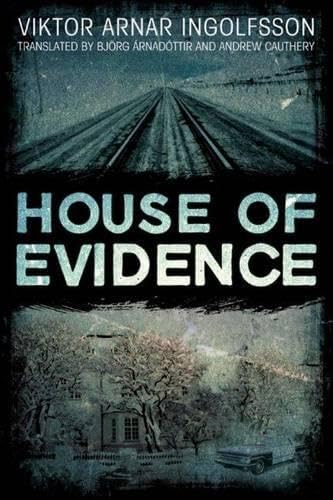
House of Evidence : Ingolfsson, Viktor Arnar, Arnadottir, Bjoerg, Cauthery, Andrew: desertcart.ae: Books Review: No, no need for slander, libel or anything else - just an expression of disappointment. As with my fellow reviewers, the idea initially grabbed my attention, but in my case the pages seemed to grow heavier as the novel went on. At first, I found the police procedural business quite interesting: I've never known the forensic Scene-Of-Crime boys followed in such detail! But with the interleaving of the victim's diaires, I began to smell the distinctly fishy odour of padding. The diary entries do effectively demonstrate the descent of a mind from enthusiasm, via obsession, to something like madness; but their sketchiness serves merely to tell when they should show - can't the author manage (or be bothered?) to realise his story more effectively? It's no worse than OK, as my three stars indicate - but no better, either. I must take issue with at least one other reviewer here: this novel IN NO WAY approaches Larsson's Millenniium trilogy in readability, characterisation, theme, or any other quality I can think of. Except, perhaps, that there is quite a lot of snow involved. Review: I really love books that make you stop reading in order to look up something you don't know; in this case, what happened in Iceland during WW2. However, "House of Evidence" is in no way a dry tome overloaded with the author's research; on the contrary, it is a well-told murder mystery which, although taking its time, finally winds up into a brilliantly unexpected conclusion entirely consistent with everything that has gone before. Although the plot - set in Iceland in 1972, but harking back to events in the first half of the twentieth century - is complex, nevertheless the author doesn't skimp on the characters. Far from being the cardboard stereotypes so often found in police procedural novels, the investigation team here are portrayed as individuals, and we have glimpses of insight into their frustrations and their triumphs. And the Kieler family, past and present, are fascinating; when I re-read this book, as I know I shall, I sense there is far more to learn of the enigmatic Elizabeth, and the true native of Jacob Senior's mental condition. Highly recommended to anyone who enjoys a complex, mysterious and ultimately very satisfying read in an unfamiliar setting.
| Customer reviews | 3.9 3.9 out of 5 stars (48) |
| Dimensions | 13.97 x 2.54 x 20.96 cm |
| Edition | Illustrated |
| ISBN-10 | 1611090997 |
| ISBN-13 | 978-1611090994 |
| Item weight | 435 g |
| Language | English |
| Print length | 398 pages |
| Publication date | 11 December 2012 |
| Publisher | Lake Union Publishing |
P**Y
No, no need for slander, libel or anything else - just an expression of disappointment. As with my fellow reviewers, the idea initially grabbed my attention, but in my case the pages seemed to grow heavier as the novel went on. At first, I found the police procedural business quite interesting: I've never known the forensic Scene-Of-Crime boys followed in such detail! But with the interleaving of the victim's diaires, I began to smell the distinctly fishy odour of padding. The diary entries do effectively demonstrate the descent of a mind from enthusiasm, via obsession, to something like madness; but their sketchiness serves merely to tell when they should show - can't the author manage (or be bothered?) to realise his story more effectively? It's no worse than OK, as my three stars indicate - but no better, either. I must take issue with at least one other reviewer here: this novel IN NO WAY approaches Larsson's Millenniium trilogy in readability, characterisation, theme, or any other quality I can think of. Except, perhaps, that there is quite a lot of snow involved.
E**S
I really love books that make you stop reading in order to look up something you don't know; in this case, what happened in Iceland during WW2. However, "House of Evidence" is in no way a dry tome overloaded with the author's research; on the contrary, it is a well-told murder mystery which, although taking its time, finally winds up into a brilliantly unexpected conclusion entirely consistent with everything that has gone before. Although the plot - set in Iceland in 1972, but harking back to events in the first half of the twentieth century - is complex, nevertheless the author doesn't skimp on the characters. Far from being the cardboard stereotypes so often found in police procedural novels, the investigation team here are portrayed as individuals, and we have glimpses of insight into their frustrations and their triumphs. And the Kieler family, past and present, are fascinating; when I re-read this book, as I know I shall, I sense there is far more to learn of the enigmatic Elizabeth, and the true native of Jacob Senior's mental condition. Highly recommended to anyone who enjoys a complex, mysterious and ultimately very satisfying read in an unfamiliar setting.
B**X
Viktor Arnar Ingolfsson's first AmazonCrossing title, The Flatey Enigma, was great fun if a rather implausible whodunit. This second one, House of Evidence, was originally published in Icelandic 4 years earlier (in 1998) than The Flatey Enigma, but is a much better book in all respects. Its scenario is fascinating - the progress of an Icelandic family against the background of Iceland and the world's 20th Century history, its plotting really assured, and its locus - an old house whose secrets, when unlocked, will surely explain the mystery - beautifully imagined. The story is set in 1973, 25 years before the book's original publication. This may at first seem odd, but is necessary to fit it to the historical events that in part shape the plot - and by giving it some historic distance, add to the general atmosphere. Historian Jacob Keiler is found shot dead at his house in Reykjavík, a house built by his grandfather, a successful merchant, back in 1910, and which Jacob, a bachelor, has turned into something of a museum for his father, also Jacob. His father was an engineer whose unrealised life's ambition was to bring the railway to Iceland. As the police investigation - carried out by quite a large team, each of whom is nicely delineated - begins, something really strange energes: Jacob senior was shot dead in the very same room nearly 30 years earlier. Don't worry about this being a spoiler, since it's on the back cover and is merely the foundation for the development of the plot. To say much more, other than that there are plenty of the expected red herrings, would however definitely count as spoilers, so I won't, except to say that the unfolding of the plot is beautifully timed, its outcome uncertain until the very end, by which time you have been carried along so well it's a real wrench it all has to finish. It's a lovely one for railway buffs as well as the rest of us, by the way, because the railway that never was is central to the story. It's a splendid story and well worth reading either as an e-book or nice sturdy paperback. A third Ingolfsson title is due in 2013 from AmazonCrossing: let's hope it as good as this one.
E**O
Started off reasonably but then fairly quickly became long-winded and dull. A part of the storyline involved the (ultimately abandoned) attempt to build railway line in Iceland - this was very boring and as I have very little inerest in building railways in Iceland or anywhere else led to another book on the charity shop pile.
K**.
Plotted with careful attention to social context, the development is paced to build, capture a satisfying sense of overall cohesion. A fine read!
Trustpilot
2 weeks ago
1 month ago