Full description not available
O**S
Whither the Washington Post?
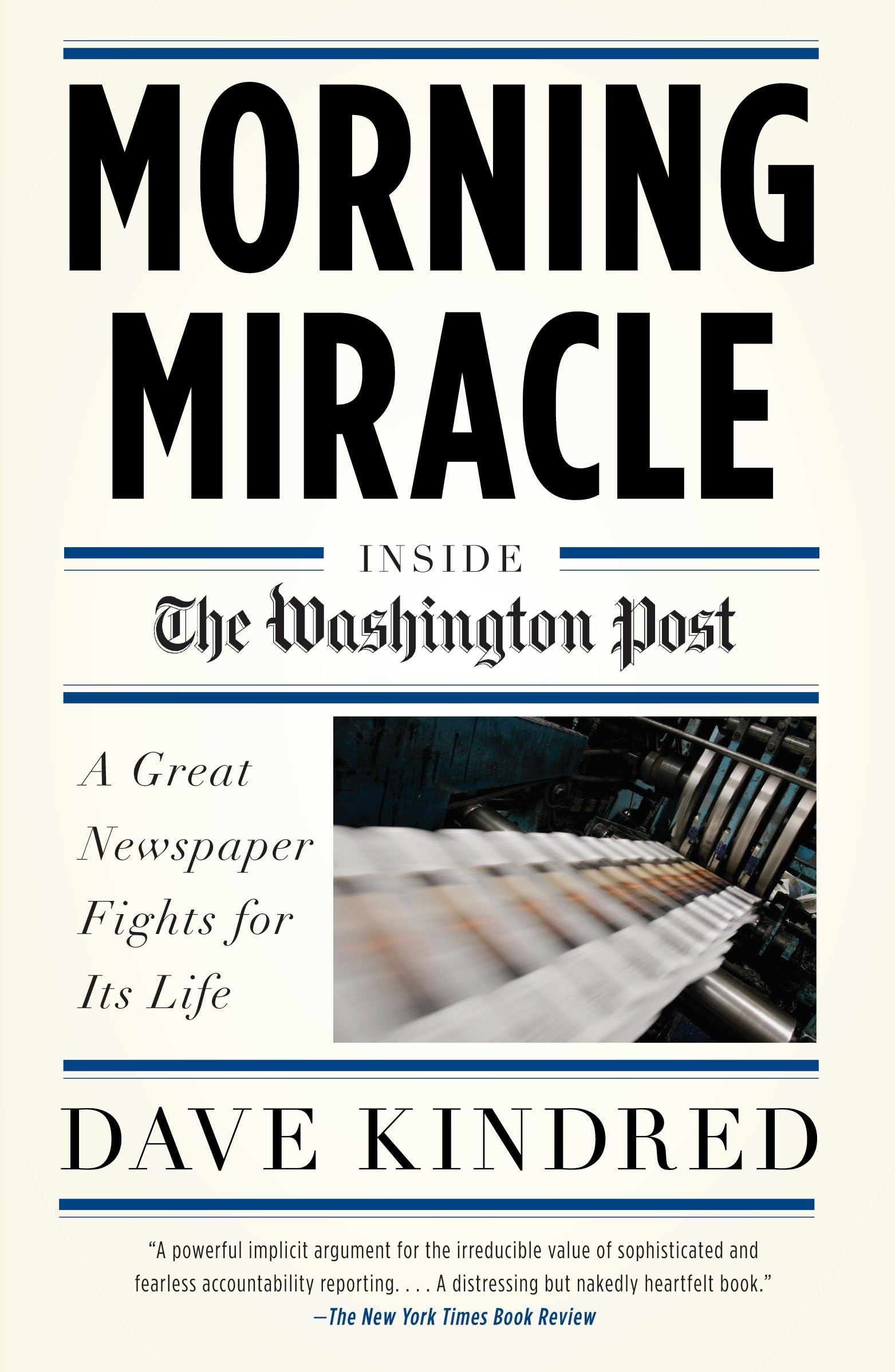
Dave Kindred's THE MORNING MIRACLE doesn't compare with Gay Talese's THE KINGDOM AND THE POWER, and isn't even the best book on the Washington Post (Katharine Graham's PERSONAL HISTORY), but it is a first-rate account of a venerable institution struggling to survive in the 21st century. The heroes are Post writers Dana Priest, Annie Hull, Anthony Shadid, Sally Jenkins and Gene Weingarten, individuals who see journalism more as a calling than a career. Walter Pincus is the old truth-telling prophet. Len Downie is revered as the near perfect editor. Ben Bradlee is almost made to walk on water. And yet, despite such talent, the Post is losing money on newsprint and the direction forward is murky, so much so that one Post writer suggests Kindred's title should be DYING WITH DIGNITY.As Kindred focuses the story on the period of time between 2005-2008, the staff knows that beloved publisher, Don Graham, will do anything to keep the print side of the paper afloat. But, in seeing his personal (a divorce settlement) and professional (age) life slipping away, he believes that the only hope is to turn to youth for leadership, particularly niece Katharine Weymouth. Understanding the business side of the Post, and more aware of the importance of its online future, Weymouth is the logical successor. But, Kindred is not placated with the choice. He finds her oblivious to the decline of the quality of the Post as the staff shrinks through forced buyouts. And, worse still, he knows that she has no ear for words, no sense of the history of print. She quotes Metro Columnist Marc Fisher as putting forth the Post's objective in a tidy fashion when he writes it is "to speak truth to power, to comfort the afflicted and afflict the comfortable." Kindred's scorching reaction, "The words were written by Finley Peter Dunne almost a century ago. Old news to people who know newspapers." But, such tough talk belies the reality that without Weymouth's bottom line agressiveness, the Post might fold altogether like the Seatlle Post-Intelligencer or the Rocky Mountain News in Denver. Kindred grudgingly knows that the Post must adapt or die.Weingarten turns out to be Kindred's sage. He pinpoints the critical difference between reading a newspaper and something online. With a newspaper, you never read what you think you will. You see different headlines and pictures and end up reading somethng you otherwise would have bypassed. Online, you pick out what you read. You confirm what you already know and you never expand.Weingarten also provides the most laugh out loud moments in the book, such as when making a graduation speech to journalism majors and telling them that the business is changing so radically that it is hard to tell what future journalists will look like. Weingarten exclaims, "I mean literally. For all we know, they might have gills and three buttocks. That's how fast things are changing. But rest assured that, however dizzying the rate of change, when what's at stake is the sacred art of truth-telling, there is always one constant. One thing that will always be the same: Your editor is going to be an idiot."In the end, Kindred concludes that the Post will no longer be the paper of excellence that the Grahams, Bradlee and Downie created anymore than today's world can be the same as the world of a generation past. But, he does take comfort that there will always be journalists who love to get the story right and won't rest until they do.For those who love words, and print, and might even still walk out into their driveway every morning to pick up the Post, this is a great book to read.
S**A
Another Miracle
AS a Washingtonian of many years and a lover of the Washington Post, I devoured this paean to my hometown paper. I picked it up yesterday and didn't put it down until this afternoon. It's a thorough telling of what made, and still makes, the Post such a great paper. In a Damon Runyonesque style, Kindred describes the many great talents, and great characters, that comprise the Post's writers, in the past and up to the present moment.Yesterday, Sulzberger, heir to the New York Times, said that he expects the paper will not have a print version "in the future." I dread that day and hope, somehow, that the Washington Post will grace my doorstep (or, more specifically, my driveway) for many years to come.
B**S
A great newspaper doing its damnest to get out of this mess alive
In 2008, San Francisco Chronicle managing editor Robert Rosenthal said the newspaper industry and the institution of journalism was caught up "in the greatest upheaval they had ever known."The internet had started the greatest revolution in communications since the Guttenberg press. From 2004-2008, 100,000 newspaper jobs were lost and 10 newspaper chains declared bankruptcy.From 2007-2009, the Washington Post lost $359 million. It's against this backdrop that Dave Kindred, a former Post sports columnist, wrote Morning Miracle, which he describes as a book "about a great newspaper doing its damnest to get out of the mess alive."Four years before the Internet became a widely used public tool, reporter Bob Kaiser issued a memo in 1992 to all the Post leaders that reflected the new-found belief that newspapers must join the electronics revolution immediately. It became known as the "boiling frog" memo.In 1994, the Post's circulation dropped for the first time in 40 years. The newspaper's glory days were starting to end. The days of 700 reporters on staff, a $100 million budget and news bureaus around the world were about to become a thing of the past.In June 1996, almost four years after the "boiling frog" memo, the Post launched [...] The website was a high stakes gamble, one that required $200 million to gain profitability.Steve Coll, one of the paper's top editors, wrote in 1999 that the biggest challenge for reporters and editors "involves adapting our work to [...] formats that emphasize speed, active interaction with readers and a new synthesis of words, pictures and sounds." He termed the Post, as it existed, to be "an idealistic editor's most extravagant imagination." He warned that it would never last forever.A pivotal point in the Post's future came when publisher Donald Graham shot down the national global web strategy, preferring that his reporters think locally and the Post remain a local newspaper. That stopped the momentum of the Web movement, limited the Post's ambition and caused Coll to resign.Even though Kindred writes "When attention spans can be measured in nano seconds, a thoughtful piece was all but a relic," he uses several articles and projects to illustrate the impact of the Post and its reporters. He focuses on the expose of soldiers' neglect at Walter Reed Hospital, the Va. Tech shootings, coverage of the Iraq war and the election of Barack Obama as President.By late 2008, the Washington Post's circulation was its lowest since 1940 and print revenue continued to fall 10 times faster than online revenue rose.Although the Washington Post and other newspapers will likely survive, it's clear that their glory days are sadly over. If you have any interest in newspapers and the changing communication era, this is an excellent book to read.
R**R
excellent book
excellent book-outstanding description of history of paper and TV stations-great review of problems surrounding Kaplan and colleges- great Amazon product
E**A
Boring, hard to read
You will like it only if you follow old fashioned information media.
Trustpilot
1 month ago
3 weeks ago