We remain fully operational. Our teams are working around the clock to ensure your deliveries continue safely.

DOWNLOAD THE APP


Customer Services
Copyright © 2025 Desertcart Holdings Limited
DOWNLOAD THE APP
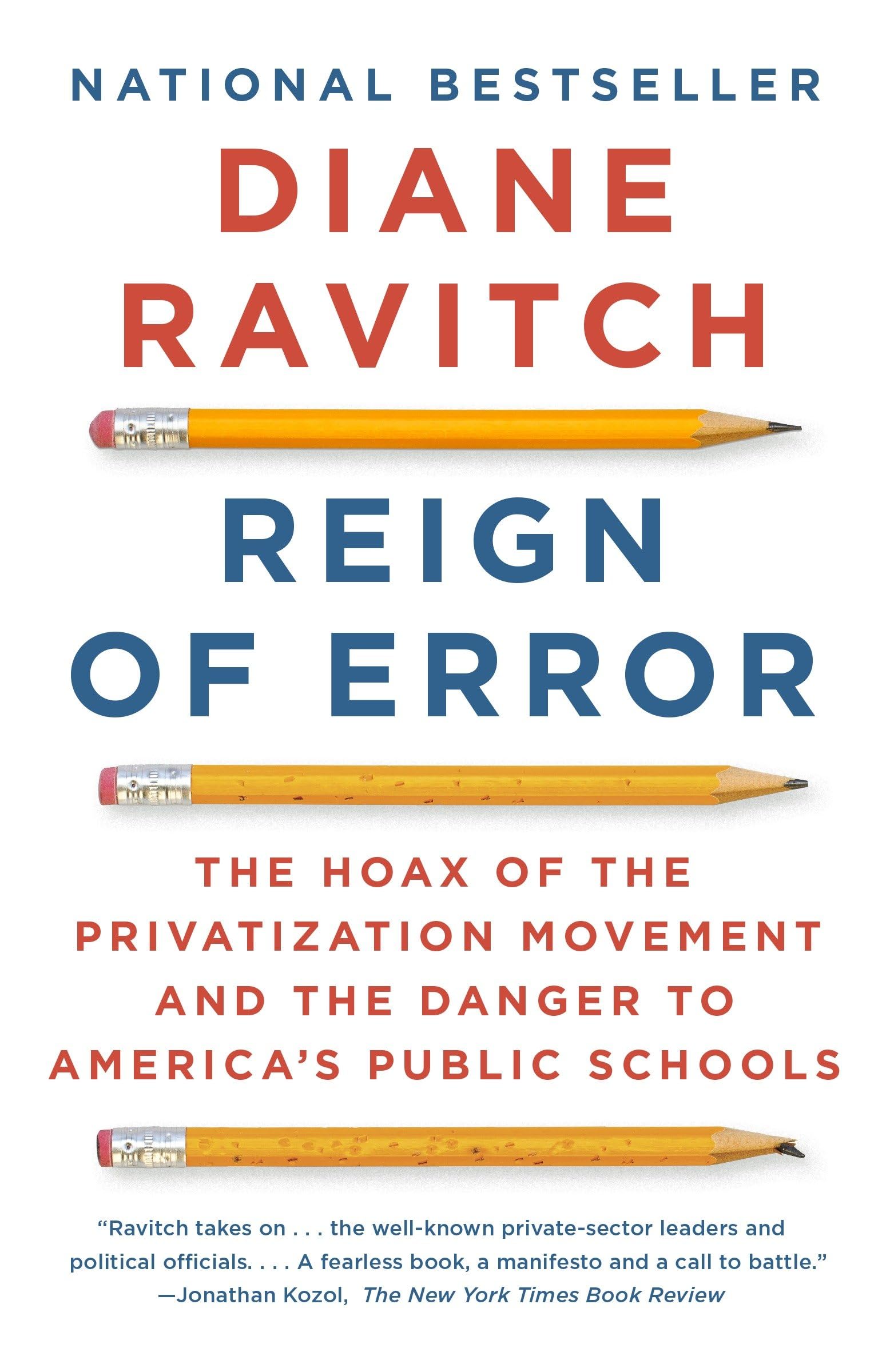
desertcart.com: Reign of Error: The Hoax of the Privatization Movement and the Danger to America's Public Schools: 9780345806352: Ravitch, Diane: Books Review: Ravitch Rises - Diane Ravitch has emerged as an iconic figure on America's political landscape. What Daniel Ellsberg was to the Vietnam War, Ravitch has become to the battle raging over public education - a truth-teller with the knowledge that comes from decades on the inside of the education "reform" movement. Her new book, Reign of Error, The Hoax of the Privatization Movement and the Danger to America's Public Schools, goes on sale Tuesday, and reveals a great deal about the nature of the epic struggle raging over the future of public education in America - and beyond. Ravitch's previous book, The Death and Life of the Great American School System, was a breakthrough. An "establishment" figure reviewed the evidence and categorically rejected the dominant reform strategies then on the ascent. What's more, Ravitch called out what she termed the "billionaire boys club" for their heavy-handed attempts to privatize the public schools. Reign of Error picks up where Death and Life left off. Over the past three years the patterns of corruption and influence have become clear, as has the evidence. Her prose is precise and accurate, and devastating. She does not mince words. The third chapter, "Who are the Corporate Reformers," provides a thumbnail portrait of the titans and their proxies. From Gates to Jeb Bush to Barack Obama, we see the web connected by the power of wealth. Some have suggested that Ravitch applies too broad a brush in her indictment. Here is what she writes: "Some in the reform movement, believing that American education is obsolete and failing, think they are promoting a necessary but painful redesign of the nation's ailing schools. Some sincerely believe they are helping poor black and brown children escape from failing public schools. Some think they are on the side of modernization and innovation. But others see an opportunity to make money in a large, risk-free, government-funded sector or an opportunity for personal advancement and power. Some believe they are acting rationally by treating the public education sector as an investment opportunity." Ravitch is not vilifying. She allows for good intentions as well as selfish ones. We do not need to look into the hearts of corporate reformers to determine that they are wrong for our schools. We just need to look at the results of their policies. And that is where Reign of Error is most useful. True to the title, the book takes on the errors that are central to the corporate reform narrative. * While we hear that schools are failing, the truth is test scores and graduation rates have never been higher. * Poverty is not an excuse for low achievement. It is a significant obstacle which must be dealt with. * Using test scores to identify and get rid of "bad" teachers will do more to harm students than help them. * Merit pay for test scores likewise has never worked. * Schools are not improved by closing them. On Teach For America, her analysis corresponds to my experiences working as a mentor teacher in Oakland: "By its design, TFA exacerbates teacher turnover or "churn." No other profession would admire and reward a program that replenished its ranks with untrained people who expected to move on to a new career in a few years. Our schools already have too much churn. Nationally, about 40 percent of teachers leave within the first five years; in high-poverty schools, the rate is 50 percent or so. Few members of TFA stay in the classroom as long as five years. Researchers have found that experience matters; the weakest teachers are in their first two years of teaching, which is understandable because they are learning how to teach and manage their classes. Researchers have also found that staff stability matters. The more that teachers come and go, the worse it is for the schools and their students. One recent study determined that teacher turnover depressed achievement in both mathematics and reading, especially in schools with more low-performing and black students. The disruption was harmful to students whose teachers left, as well as to other students in the school. Turnover itself is harmful, possibly because it undermines the cohesion and collegiality of the community of educators." On the subject of charter schools, Ravitch does not issue the blanket condemnation she has been accused of. Instead, she makes specific observations of the practices of charters around the country, and their impact on the local communities they inhabit. And she raises some critical questions: "Will charter schools contribute to the increasing segregation of American society along lines of race and class? Will the motivated students congregate in charter schools while the unmotivated cluster in what remains of the public schools? Will the concentration of charter schools in urban districts sound a death knell for urban public education? Why do the elites support the increased stratification of American society? If charter schools are not more successful on average than the public schools they replace, what is accomplished by demolishing public education? What is the rationale for authorizing for-profit charters or charter management organizations with high-paid executives, since taxpayers will pay their salaries, with no benefit to their own children?" On the subject of online education, Ravitch describes recent boondoggles, and observes, "Online technology surely holds immense potential to enliven the classroom. But the story of cyber charters warns us that the profit motive operates in conflict with the imperative for high quality education." When Ravitch discusses vouchers, her dedication to quality education shines through. "If the market were always right, the best products would always be the most successful, but that is not necessarily the case. If the market were always right, only the highest quality books, movies, and television programs would top the charts, but that is not necessarily the case." "Would the free market produce better education? Should the state subsidize schools where teachers are not certified and meet no particular standard of professionalism? Should taxpayers fund religious schools whose beliefs do not accord with modern science or history?" Ravitch was faulted for her last book's lack of solutions to the problems she identified. The last third of Reign of Error is devoted to concrete policy solutions, and evidence that they are sound. Prenatal care, early childhood education, and, of course, a solid, well-rounded education for every child. Smaller class size and wraparound social services are also endorsed. The issue of testing is of critical importance, because this, more than anything, has emerged as the linchpin of corporate reform. Her seventh solution is: "Eliminate high-stakes standardized testing and rely instead on assessments that allow students to demonstrate what they know and can do." Every time we decry the effects of standardized tests, we are told that this is the only way to hold schools and teachers accountable. Ravitch offers another idea. "Just imagine that every school district and state had a team of expert educators who regularly visited and inspected schools. They would review student work and meet with the principal, teachers, parents and students. They would analyze the demographics, the curriculum, the staff, the resources, and the condition of the school. They would interview educators to gauge the progress of students who advanced to the next level of schooling, from elementary school to middle school, from middle school to high school, and from high school to postsecondary studies. Schools that are struggling to meet the needs of their students would get frequent visits, no less than annually. Schools that are successful would require fewer inspections. The evaluation team would make recommendations to help the school improve and send in support personnel when needed. It would prod the authorities to make sure the school got the resources and support it needed. The goal of the evaluation should be continuous improvement, not a letter grade or a threat of closure." In the final chapters of Reign of Error, Ravitch explains the pernicious effect of privatization: "But as school choice becomes the basis for public policy, the school becomes not a community institution but an institution that meets the needs of its customers. The school reaches across district lines to find customers; it markets its offerings to potential students. Districts poach students from each other, in hopes of getting more dollars. The customers choose or reject the school, as they would choose or reject a restaurant; it's their choice. The community no longer feels any ties to the school, because the school is not part of the community. The community no longer feels obliged to support the school, because it is not theirs." Educators feel that Diane Ravitch speaks for us in a way that few others do. That is clearest when she writes this, in bringing her book to a close: "Genuine school reform must be built on hope, not fear; on encouragement, not threats; on inspiration, not compulsion; on trust, not carrots and sticks; on belief in the dignity of the human person, not a slavish devotion to data; on support and mutual respect, not a regime of punishment and blame. To be lasting, school reform must rely on collaboration and teamwork among students, parents, teachers, principals, administrators and local communities." Ravitch's own journey, which has taken her from inside the first Bush administration to standing alongside those protesting Obama's education policies on the National Mall, is remarkable. This book provides us with a definitive study of the state of education reform in the modern age. This is a living history written by someone willing to make it, not just write about it. In the year to come there will be study groups gathering by the hundreds to talk over this book and better understand what is happening to our schools. This book was not written simply to be read. Like the best books, it was written to be discussed, wrestled with, and acted upon. Review: Concerned about the education of America's future citizens, then read this book - If you want to know what's really going on with reform initiatives aimed at America's K-12 education system, then this book is a must read. Get the facts about test scores, the so-called achievement gap, The National Assessment of Educational Progress (NAEP), the Program for International Student Assessment (PISA), high school and college graduation rates, as well as learn about the problem with Teach for America (TFA), the work of the American Legislative Exchange Council, (ALEC), how poverty affects academic achievement, and much more--including solutions based on evidence, not slogans, reckless speculation, myths or manufactured crises. "Reign of Error" extends and deepens the author's discussion of her changed thinking about education reform that began in 2010 with her book "The Death and Life of the Great American School System: How Testing and Choice Are Undermining Education." She sees American public schools still facing the threat of reform aimed at the privatization of America's public school. The book also expands on the work of David C. Berliner and Bruce J. Biddle who defended public education in their 1995 book The Manufactured Crisis: Myths, Fraud, and the Attack on America's Public Schools wherein they attempted to debunk their self-described myth that test scores in America's schools are falling, that illiteracy is rising, and that better funding has no benefit--refuting the statistics-based studies that have led to notion that U.S. taxpayers should expect more because they pay more. The back story is that Ravitch was once a reformer. She served as an assistant secretary of education under President George H.W. Bush and later helped develop national learning assessments under President Bill Clinton. She advocated for charter schools -- institutions run by private entities, sometimes for-profit companies, that receive public money -- and she promoted using student test scores to measure teacher performance. She backed many of the views now supported by leading reform activists, including Bill and Melinda Gates, the Walton family of Wal-Mart, and News Corps' Rupert Murdoch. That's why her contrarian views and arguments are all the more compelling. Early in the book she writes: "The reformers are putting the nation's children on a train that is headed for a cliff. If you insist on driving that train right over the cliff, you will never reach your hoped-for destination of excellence for all. Instead, you will inflict harm on millions of children and reduce the quality of their educations. You will squander billions of dollars on failed schemes that should have been spent on realistic, evidence-based ways of improving our public schools, our society, and the lives of children." The biggest problem with the reformers, Ravitch writes, is that there's largely nothing to reform: High school graduation rates are at an all-time high, and reading scores for fourth-grade white, black, Hispanic and Asian students were significantly higher in 2011 than they were in 1992. In the chapter titled "Schools Don't Improve if They Are Closed," Ravitch gives an example via President-elect Barack Obama's December 2008, announcement of his choice of former Chicago Public Schools chief Arne Duncan to be secretary of education. The setting of the announcement was the Dodge Renaissance Academy in Chicago's East Garfield Park neighborhood--a significant setting since the elementary school had undergone a transformation during Duncan's stewardship of Chicago's public schools and was serving as one of the centerpieces of Duncan's brand of education reform. In 2002, Duncan closed the chronically low-performing school, fired the teachers and handed the keys to the building to an outside nonprofit group. Opened again a year later, the school's academic performance saw near-miraculous gains on state standardized tests, despite the fact that more than 90 percent of the students came from low-income families. When presenting Duncan at Dodge, Obama made clear his intention as president to promote reforming America's public schools as part of his education agenda, saying: "He's shut down failing schools and replaced their entire staffs, even when it was unpopular. This school right here, Dodge Renaissance Academy, is a perfect example. Since the school was revamped and reopened in 2003, the number of students meeting state standards has more than tripled." According to Ravitch, the miraculous turnaround evaporated. By 2013, Chicago school officials closed the Dodge Academy again, along with the other two elementary schools that Duncan closed and "revamped'" in 2002. Note: According to its website, the school is still around, although moved to a new Academy for Urban School Leadership (AUSL) facility as one of 29 Chicago Public Schools managed by AUSL. Today, Ravitch is one of the most outspoken advocates against school reform, including the government's No Child Left Behind (NCLB) and Race to the Top (RTT) reform initiatives. These programs support standards-based education reform-- expanding the federal role in public education. In her book, The Death and Life of the Great American School System, Ravitch, said educators are worried that the NCLB mandate that all students meet proficiency standards by 2014 will result in the dismantling of public schools across the nation. According to Ravitch, reformers seek to tie teacher salaries to student high-stakes (reward-punishment) test scores , recruit young and inexperienced college graduates to teach in struggling schools (Teach for America, TFA), and fund voucher programs to allow students to use public tax dollars to attend private schools. She writes that the "the transfer of public funds to private management and the creation of thousands of deregulated, unsupervised, and unaccountable schools have opened the public coffers to profiteering, fraud, and exploitation by large and small entrepreneurs." Ravitch believes America's public school system is under attack from corporate interests and Wall Street investment firms seeking to profit off the American taxpayer via "a deliberate effort to replace public education with a privately managed, free-market system of schooling." Although Ravitch writes with depth and passion born of experience it must be recognized that she's up against formidable adversaries--including Richard Barth, chief executive of the Knowledge is Power Program chain of charter schools, which receive funding from the Walton and Gates foundations, and Barth's wife, TFA founder Wendy Kopp, who is close allies with former D.C. schools chancellor Michelle Rhee, a former TFA teacher to whom Ravitch dedicates an entire chapter titled "The Mystery of Michelle Rhee." Ravitch also links the reformers to the influential American Legislative Exchange Council, (ALEC) which helped write legislation in several states to ease the introduction of new charter schools. Ravitch proposes no less than 11 solutions to America's education problems, to wit: 1. Provide good prenatal care for every pregnant woman. 2. Make high-quality early childhood education available to all children. 3. Every school should have a full, balanced, and rich curriculum, including the arts, science, history, literature, civics, geography, foreign languages, mathematics, and physical education, 4. Reduce class sizes to improve student achievement and behavior. 5. Ban for-profit charters and charter chains and ensure that charter schools collaborate with public schools to support better education for all children. 6. Provide the medical and social services that poor children need to keep up with their advantaged peers. 7. Eliminate high-stakes standardized testing and rely instead on assessments that allow students to demonstrate what they know and can do. 8. Insist that teachers, principals, and superintendents be professional educators. 9. Public schools should be controlled by elected school boards or by boards in large cities appointed for a set term by more than one elected official. 10. Devise actionable strategies and specific goals to reduce racial segregation and poverty. 11. Recognize that public education is a public responsibility, not a consumer good. "Are all of these changes expensive?" Ravitch says: "Yes, but not nearly as expensive as the social and economic costs of crime, illness, violence, despair, and wasted human talent." She believes that "an educated parent would not accept a school where many weeks of every school year were preparing for state tests....(and would not tolerate a school that cut back or eliminated the arts to spend more time preparing for state tests." She also believes that certain private schools may be models for public schools--pointing to the rich and diverse curricula at among others: Sidwell Friends in Washington, Phillips Academy in Andover, Mass., and the Lakeside School in Seattle. I found Ravitch unsparing in her myth-busting assault on reformers that take every opportunity to exploit PISA test scores to manufacture a crisis de jour in education, scapegoat public schools while diverting school resources, bash teachers' unions, and effectively deprive teachers of professional dignity. Her arguments are backed by data including 41 charts and an abundance of explanatory notes. Finally, here are two Ravitch inspired takeaways: 1) No matter how much we improve our public schools, great schools alone cannot solve the deeply rooted systemic problems of our society--the inevitable result of poverty, racial segregation, and underfunding is low academic performance by any measure; and 2) Protecting our public schools against privatization and saving them for future generations of American children is the civil rights issue of our time.
| Best Sellers Rank | #288,797 in Books ( See Top 100 in Books ) #11 in Charter Schools #347 in Education Administration (Books) #1,690 in Sociology Reference |
| Customer Reviews | 4.6 4.6 out of 5 stars (773) |
| Dimensions | 5.23 x 0.89 x 7.9 inches |
| Edition | Reprint |
| ISBN-10 | 0345806352 |
| ISBN-13 | 978-0345806352 |
| Item Weight | 11.2 ounces |
| Language | English |
| Print length | 416 pages |
| Publication date | August 26, 2014 |
| Publisher | Vintage |
A**Y
Ravitch Rises
Diane Ravitch has emerged as an iconic figure on America's political landscape. What Daniel Ellsberg was to the Vietnam War, Ravitch has become to the battle raging over public education - a truth-teller with the knowledge that comes from decades on the inside of the education "reform" movement. Her new book, Reign of Error, The Hoax of the Privatization Movement and the Danger to America's Public Schools, goes on sale Tuesday, and reveals a great deal about the nature of the epic struggle raging over the future of public education in America - and beyond. Ravitch's previous book, The Death and Life of the Great American School System, was a breakthrough. An "establishment" figure reviewed the evidence and categorically rejected the dominant reform strategies then on the ascent. What's more, Ravitch called out what she termed the "billionaire boys club" for their heavy-handed attempts to privatize the public schools. Reign of Error picks up where Death and Life left off. Over the past three years the patterns of corruption and influence have become clear, as has the evidence. Her prose is precise and accurate, and devastating. She does not mince words. The third chapter, "Who are the Corporate Reformers," provides a thumbnail portrait of the titans and their proxies. From Gates to Jeb Bush to Barack Obama, we see the web connected by the power of wealth. Some have suggested that Ravitch applies too broad a brush in her indictment. Here is what she writes: "Some in the reform movement, believing that American education is obsolete and failing, think they are promoting a necessary but painful redesign of the nation's ailing schools. Some sincerely believe they are helping poor black and brown children escape from failing public schools. Some think they are on the side of modernization and innovation. But others see an opportunity to make money in a large, risk-free, government-funded sector or an opportunity for personal advancement and power. Some believe they are acting rationally by treating the public education sector as an investment opportunity." Ravitch is not vilifying. She allows for good intentions as well as selfish ones. We do not need to look into the hearts of corporate reformers to determine that they are wrong for our schools. We just need to look at the results of their policies. And that is where Reign of Error is most useful. True to the title, the book takes on the errors that are central to the corporate reform narrative. * While we hear that schools are failing, the truth is test scores and graduation rates have never been higher. * Poverty is not an excuse for low achievement. It is a significant obstacle which must be dealt with. * Using test scores to identify and get rid of "bad" teachers will do more to harm students than help them. * Merit pay for test scores likewise has never worked. * Schools are not improved by closing them. On Teach For America, her analysis corresponds to my experiences working as a mentor teacher in Oakland: "By its design, TFA exacerbates teacher turnover or "churn." No other profession would admire and reward a program that replenished its ranks with untrained people who expected to move on to a new career in a few years. Our schools already have too much churn. Nationally, about 40 percent of teachers leave within the first five years; in high-poverty schools, the rate is 50 percent or so. Few members of TFA stay in the classroom as long as five years. Researchers have found that experience matters; the weakest teachers are in their first two years of teaching, which is understandable because they are learning how to teach and manage their classes. Researchers have also found that staff stability matters. The more that teachers come and go, the worse it is for the schools and their students. One recent study determined that teacher turnover depressed achievement in both mathematics and reading, especially in schools with more low-performing and black students. The disruption was harmful to students whose teachers left, as well as to other students in the school. Turnover itself is harmful, possibly because it undermines the cohesion and collegiality of the community of educators." On the subject of charter schools, Ravitch does not issue the blanket condemnation she has been accused of. Instead, she makes specific observations of the practices of charters around the country, and their impact on the local communities they inhabit. And she raises some critical questions: "Will charter schools contribute to the increasing segregation of American society along lines of race and class? Will the motivated students congregate in charter schools while the unmotivated cluster in what remains of the public schools? Will the concentration of charter schools in urban districts sound a death knell for urban public education? Why do the elites support the increased stratification of American society? If charter schools are not more successful on average than the public schools they replace, what is accomplished by demolishing public education? What is the rationale for authorizing for-profit charters or charter management organizations with high-paid executives, since taxpayers will pay their salaries, with no benefit to their own children?" On the subject of online education, Ravitch describes recent boondoggles, and observes, "Online technology surely holds immense potential to enliven the classroom. But the story of cyber charters warns us that the profit motive operates in conflict with the imperative for high quality education." When Ravitch discusses vouchers, her dedication to quality education shines through. "If the market were always right, the best products would always be the most successful, but that is not necessarily the case. If the market were always right, only the highest quality books, movies, and television programs would top the charts, but that is not necessarily the case." "Would the free market produce better education? Should the state subsidize schools where teachers are not certified and meet no particular standard of professionalism? Should taxpayers fund religious schools whose beliefs do not accord with modern science or history?" Ravitch was faulted for her last book's lack of solutions to the problems she identified. The last third of Reign of Error is devoted to concrete policy solutions, and evidence that they are sound. Prenatal care, early childhood education, and, of course, a solid, well-rounded education for every child. Smaller class size and wraparound social services are also endorsed. The issue of testing is of critical importance, because this, more than anything, has emerged as the linchpin of corporate reform. Her seventh solution is: "Eliminate high-stakes standardized testing and rely instead on assessments that allow students to demonstrate what they know and can do." Every time we decry the effects of standardized tests, we are told that this is the only way to hold schools and teachers accountable. Ravitch offers another idea. "Just imagine that every school district and state had a team of expert educators who regularly visited and inspected schools. They would review student work and meet with the principal, teachers, parents and students. They would analyze the demographics, the curriculum, the staff, the resources, and the condition of the school. They would interview educators to gauge the progress of students who advanced to the next level of schooling, from elementary school to middle school, from middle school to high school, and from high school to postsecondary studies. Schools that are struggling to meet the needs of their students would get frequent visits, no less than annually. Schools that are successful would require fewer inspections. The evaluation team would make recommendations to help the school improve and send in support personnel when needed. It would prod the authorities to make sure the school got the resources and support it needed. The goal of the evaluation should be continuous improvement, not a letter grade or a threat of closure." In the final chapters of Reign of Error, Ravitch explains the pernicious effect of privatization: "But as school choice becomes the basis for public policy, the school becomes not a community institution but an institution that meets the needs of its customers. The school reaches across district lines to find customers; it markets its offerings to potential students. Districts poach students from each other, in hopes of getting more dollars. The customers choose or reject the school, as they would choose or reject a restaurant; it's their choice. The community no longer feels any ties to the school, because the school is not part of the community. The community no longer feels obliged to support the school, because it is not theirs." Educators feel that Diane Ravitch speaks for us in a way that few others do. That is clearest when she writes this, in bringing her book to a close: "Genuine school reform must be built on hope, not fear; on encouragement, not threats; on inspiration, not compulsion; on trust, not carrots and sticks; on belief in the dignity of the human person, not a slavish devotion to data; on support and mutual respect, not a regime of punishment and blame. To be lasting, school reform must rely on collaboration and teamwork among students, parents, teachers, principals, administrators and local communities." Ravitch's own journey, which has taken her from inside the first Bush administration to standing alongside those protesting Obama's education policies on the National Mall, is remarkable. This book provides us with a definitive study of the state of education reform in the modern age. This is a living history written by someone willing to make it, not just write about it. In the year to come there will be study groups gathering by the hundreds to talk over this book and better understand what is happening to our schools. This book was not written simply to be read. Like the best books, it was written to be discussed, wrestled with, and acted upon.
F**T
Concerned about the education of America's future citizens, then read this book
If you want to know what's really going on with reform initiatives aimed at America's K-12 education system, then this book is a must read. Get the facts about test scores, the so-called achievement gap, The National Assessment of Educational Progress (NAEP), the Program for International Student Assessment (PISA), high school and college graduation rates, as well as learn about the problem with Teach for America (TFA), the work of the American Legislative Exchange Council, (ALEC), how poverty affects academic achievement, and much more--including solutions based on evidence, not slogans, reckless speculation, myths or manufactured crises. "Reign of Error" extends and deepens the author's discussion of her changed thinking about education reform that began in 2010 with her book "The Death and Life of the Great American School System: How Testing and Choice Are Undermining Education." She sees American public schools still facing the threat of reform aimed at the privatization of America's public school. The book also expands on the work of David C. Berliner and Bruce J. Biddle who defended public education in their 1995 book The Manufactured Crisis: Myths, Fraud, and the Attack on America's Public Schools wherein they attempted to debunk their self-described myth that test scores in America's schools are falling, that illiteracy is rising, and that better funding has no benefit--refuting the statistics-based studies that have led to notion that U.S. taxpayers should expect more because they pay more. The back story is that Ravitch was once a reformer. She served as an assistant secretary of education under President George H.W. Bush and later helped develop national learning assessments under President Bill Clinton. She advocated for charter schools -- institutions run by private entities, sometimes for-profit companies, that receive public money -- and she promoted using student test scores to measure teacher performance. She backed many of the views now supported by leading reform activists, including Bill and Melinda Gates, the Walton family of Wal-Mart, and News Corps' Rupert Murdoch. That's why her contrarian views and arguments are all the more compelling. Early in the book she writes: "The reformers are putting the nation's children on a train that is headed for a cliff. If you insist on driving that train right over the cliff, you will never reach your hoped-for destination of excellence for all. Instead, you will inflict harm on millions of children and reduce the quality of their educations. You will squander billions of dollars on failed schemes that should have been spent on realistic, evidence-based ways of improving our public schools, our society, and the lives of children." The biggest problem with the reformers, Ravitch writes, is that there's largely nothing to reform: High school graduation rates are at an all-time high, and reading scores for fourth-grade white, black, Hispanic and Asian students were significantly higher in 2011 than they were in 1992. In the chapter titled "Schools Don't Improve if They Are Closed," Ravitch gives an example via President-elect Barack Obama's December 2008, announcement of his choice of former Chicago Public Schools chief Arne Duncan to be secretary of education. The setting of the announcement was the Dodge Renaissance Academy in Chicago's East Garfield Park neighborhood--a significant setting since the elementary school had undergone a transformation during Duncan's stewardship of Chicago's public schools and was serving as one of the centerpieces of Duncan's brand of education reform. In 2002, Duncan closed the chronically low-performing school, fired the teachers and handed the keys to the building to an outside nonprofit group. Opened again a year later, the school's academic performance saw near-miraculous gains on state standardized tests, despite the fact that more than 90 percent of the students came from low-income families. When presenting Duncan at Dodge, Obama made clear his intention as president to promote reforming America's public schools as part of his education agenda, saying: "He's shut down failing schools and replaced their entire staffs, even when it was unpopular. This school right here, Dodge Renaissance Academy, is a perfect example. Since the school was revamped and reopened in 2003, the number of students meeting state standards has more than tripled." According to Ravitch, the miraculous turnaround evaporated. By 2013, Chicago school officials closed the Dodge Academy again, along with the other two elementary schools that Duncan closed and "revamped'" in 2002. Note: According to its website, the school is still around, although moved to a new Academy for Urban School Leadership (AUSL) facility as one of 29 Chicago Public Schools managed by AUSL. Today, Ravitch is one of the most outspoken advocates against school reform, including the government's No Child Left Behind (NCLB) and Race to the Top (RTT) reform initiatives. These programs support standards-based education reform-- expanding the federal role in public education. In her book, The Death and Life of the Great American School System, Ravitch, said educators are worried that the NCLB mandate that all students meet proficiency standards by 2014 will result in the dismantling of public schools across the nation. According to Ravitch, reformers seek to tie teacher salaries to student high-stakes (reward-punishment) test scores , recruit young and inexperienced college graduates to teach in struggling schools (Teach for America, TFA), and fund voucher programs to allow students to use public tax dollars to attend private schools. She writes that the "the transfer of public funds to private management and the creation of thousands of deregulated, unsupervised, and unaccountable schools have opened the public coffers to profiteering, fraud, and exploitation by large and small entrepreneurs." Ravitch believes America's public school system is under attack from corporate interests and Wall Street investment firms seeking to profit off the American taxpayer via "a deliberate effort to replace public education with a privately managed, free-market system of schooling." Although Ravitch writes with depth and passion born of experience it must be recognized that she's up against formidable adversaries--including Richard Barth, chief executive of the Knowledge is Power Program chain of charter schools, which receive funding from the Walton and Gates foundations, and Barth's wife, TFA founder Wendy Kopp, who is close allies with former D.C. schools chancellor Michelle Rhee, a former TFA teacher to whom Ravitch dedicates an entire chapter titled "The Mystery of Michelle Rhee." Ravitch also links the reformers to the influential American Legislative Exchange Council, (ALEC) which helped write legislation in several states to ease the introduction of new charter schools. Ravitch proposes no less than 11 solutions to America's education problems, to wit: 1. Provide good prenatal care for every pregnant woman. 2. Make high-quality early childhood education available to all children. 3. Every school should have a full, balanced, and rich curriculum, including the arts, science, history, literature, civics, geography, foreign languages, mathematics, and physical education, 4. Reduce class sizes to improve student achievement and behavior. 5. Ban for-profit charters and charter chains and ensure that charter schools collaborate with public schools to support better education for all children. 6. Provide the medical and social services that poor children need to keep up with their advantaged peers. 7. Eliminate high-stakes standardized testing and rely instead on assessments that allow students to demonstrate what they know and can do. 8. Insist that teachers, principals, and superintendents be professional educators. 9. Public schools should be controlled by elected school boards or by boards in large cities appointed for a set term by more than one elected official. 10. Devise actionable strategies and specific goals to reduce racial segregation and poverty. 11. Recognize that public education is a public responsibility, not a consumer good. "Are all of these changes expensive?" Ravitch says: "Yes, but not nearly as expensive as the social and economic costs of crime, illness, violence, despair, and wasted human talent." She believes that "an educated parent would not accept a school where many weeks of every school year were preparing for state tests....(and would not tolerate a school that cut back or eliminated the arts to spend more time preparing for state tests." She also believes that certain private schools may be models for public schools--pointing to the rich and diverse curricula at among others: Sidwell Friends in Washington, Phillips Academy in Andover, Mass., and the Lakeside School in Seattle. I found Ravitch unsparing in her myth-busting assault on reformers that take every opportunity to exploit PISA test scores to manufacture a crisis de jour in education, scapegoat public schools while diverting school resources, bash teachers' unions, and effectively deprive teachers of professional dignity. Her arguments are backed by data including 41 charts and an abundance of explanatory notes. Finally, here are two Ravitch inspired takeaways: 1) No matter how much we improve our public schools, great schools alone cannot solve the deeply rooted systemic problems of our society--the inevitable result of poverty, racial segregation, and underfunding is low academic performance by any measure; and 2) Protecting our public schools against privatization and saving them for future generations of American children is the civil rights issue of our time.
L**N
I am very sympathetic with everything Diane Ravitch writes, but this book repeated everything many, many times more than necessary, to the point of really annoying me. On the issues, the only aspect left unaddressed and needing to be addressed is the local tax base funding the schools and making them as a result very unequal in their ability to provide a decent educational experience to all. . I am in favor of national standards...we are after all one country....and I believe schools should be funded equally on a per child basis. Local school boards have a role to play, but there can be a lot of reinventing the wheel and making important decisions about schools without the expertise available from those spending their lives studying, researching and working in schools.
A**L
This book undoes most of the myths about the current corporate educational reform agenda and exposes, in the US all the destructive policies that Michael Gove is doing in the UK.
Á**O
La autora describe y analiza minuciosamente la importancia del sistema de educación pública norteamericano para su democracia y los ataques de la mancuerna empresarial y autoridades gubernamentales para convertirlo en un negocio más. Al apuntar los principios y cimientos democráticos de la educación pública, la autora da pautas claras para reconstruirla desde una perspectiva humanista. En México estamos viendo está película destructiva con todos los trucos señalados en este gran libro, no falta ni uno, incluyendo la película con los mismos efectos especiales. Un libro muy recomendable para todos aquellos formados en escuelas públicas. Y, por qué no? También para los de la escuela privada y para aquellos que quieren destruirla y engullir a tan venerable institución.
J**Y
Good book
Trustpilot
5 days ago
1 month ago