We remain fully operational. Our teams are working around the clock to ensure your deliveries continue safely.

DOWNLOAD THE APP


Customer Services
Copyright © 2025 Desertcart Holdings Limited
DOWNLOAD THE APP
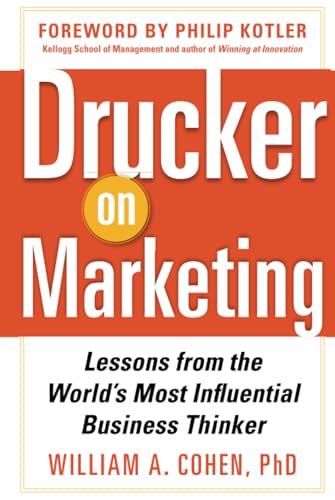



Drucker on Marketing: Lessons from the World's Most Influential Business Thinker [COHEN] on desertcart.com. *FREE* shipping on qualifying offers. Drucker on Marketing: Lessons from the World's Most Influential Business Thinker Review: It's all About Marketing - Perfect companion reader for Marketing Graduates, especially for MBAs. Marketing, says Drucker, is much more encompassing that simply advertising and selling. Great leaders are also saavy marketing managers. Review: Five Stars - Good quality and delivered quickly.


| Best Sellers Rank | #919,288 in Books ( See Top 100 in Books ) #158 in Knowledge Capital (Books) #273 in Business Marketing #320 in Market Research Business (Books) |
| Customer Reviews | 4.0 4.0 out of 5 stars (18) |
| Dimensions | 6 x 0.84 x 9 inches |
| Edition | 1st |
| ISBN-10 | 0071778624 |
| ISBN-13 | 978-0071778626 |
| Item Weight | 2.31 pounds |
| Language | English |
| Print length | 288 pages |
| Publication date | September 26, 2012 |
| Publisher | McGraw Hill |
G**M
It's all About Marketing
Perfect companion reader for Marketing Graduates, especially for MBAs. Marketing, says Drucker, is much more encompassing that simply advertising and selling. Great leaders are also saavy marketing managers.
N**M
Five Stars
Good quality and delivered quickly.
D**G
There is no normal
Those of us who have read Peter Drucker on management spend our lives wishing every manager would read him and apply the wisdom, so this is book starts off with a great pedigree. But Drucker was far more than mere management. Sprinkled throughout were huge object lessons for marketing as well. This book pulls together the best of the marketing advice in one compact package. Peter Drucker used to say that management gurus come and go, and as soon as he died, he would be forgotten like all the rest. It is Bill Cohen's mission that this not be so, and that the work of Peter Drucker must help influence managers and entrepreneurs of all stripes for all time. Thank goodness for Bill Cohen. The simple, direct style of Peter Drucker is replicated in this book. We get the message and we get examples. It doesn't bother Bill Cohen that he repeats himself again and again; the message must be imprinted, and the reader must not be diverted to some previous page for a reference or story. It's an example of Peter Drucker's influence. The essence of it all is that marketing is the entire enterprise as seen by the customer. As such, marketing is not only not Sales, it can be and often is in actual conflict with Sales. Sales is focused on selling, to the exclusion of all else. Marketing carries responsibility for customer service, brand, reputation, labor relations, shareholders - basically everything everyone thinks they know about the product and the company. This is how I've always looked at business in my career in marketing, and it was often frustrating because of the traditionalists who would not hear of such heresy. Early in the book, Cohen touches that nerve when he says "It is sometimes difficult to get the idea across without seeming to appear to be saying you want to run everything." That's the conflict in a nutshell. It has been my life for 35 years. Cohen cites the example of Fedex Zapmail, a fax service in the 1980s. I was marketing manager for a similar service at Canada Post, and my eight page analysis of why it was doomed to fail within three years caused no end of aggravation, and was of course, totally ignored. I left rather than watch the agony. Fedex also learned the hard way, losing well over $300 million on their version, right on cue. Whenever I felt outgunned, I read some more Drucker and renewed my faith - in myself and the the job I was doing. He's good. He's important. Drucker showed that customers don't purchase goods or services; they purchase satisfaction, and if your company is not about providing satisfaction, trouble lies ahead. Turn it around and Drucker puts it another way: there is only one valid reason for a business to exist - to create a customer. Not bend a market to your product, not find a way into the psyche of the consumer, but create a customer. That's a different mindset - a real marketing mindset. Would that every entrepreneur could see these words. But clearly they don't. We have banks that look at their clients in terms of lock-in, airlines that feel free to be as obnoxious and abusive to customers as they see fit on any given day, and elected representatives who represent only their own ideologies and not the voters who put them there. There is need for this book. My only disappointment was in the examples, which I often found annoying. They are simplistic and superficial to put it mildly (Hillary Clinton simply had to beat Barack Obama for the nomination because she had a longer track record). Companies that have stumbled and faltered are cited for their brief moment when they might have made a good decision (e.g. Rolls Royce, which later went bankrupt, was broken up and the pieces sold off). It takes away from the strong clear message of the master: business of any kind, goods services, nonprofits, government - all have only two missions: innovation and marketing. Everything else is a cost. Leadership itself is marketing. Until and unless managers start looking at themselves this way, we will not realize anything like our potential. Let me give the last word to Drucker: What "everyone knows" - is usually wrong. Thank you Peter Drucker, and thank you Bill Cohen.
P**L
Poorly written
I was required to read this for a marketing class and disliked it. While I am sure that William Cohen can be regarded as a management expert, he should leave writing books to those of us who know how to construct straightforward, cohesive chapters and can write meaningful, useful prose from which information can be easily gleaned.
J**I
Interesting, but not cohesive
As a huge Drucker fan, I was interested in this title. However, too much time was spent summarizing in less than creative ways. It is not a bad book, not one I'd readily recommend. Go to the source.
Trustpilot
3 weeks ago
1 month ago