
✨ Seal the grain, save the planet, and paint like a pro! 🌿
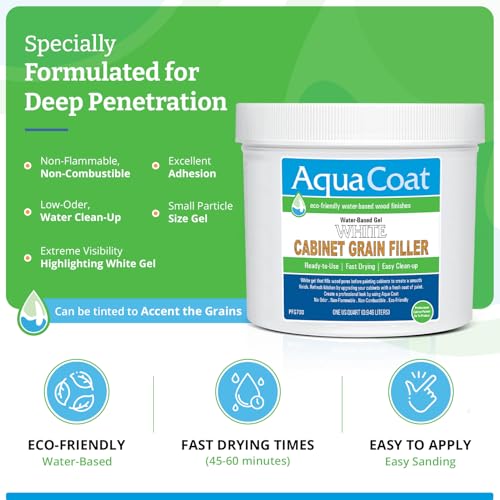
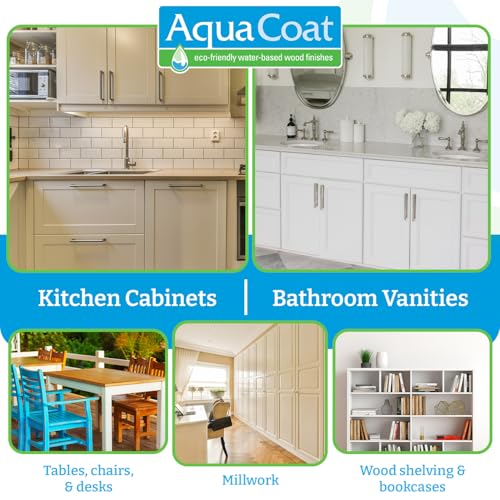
Aqua Coat Water-Based White Cabinet Grain Filler Gel is a premium, eco-friendly wood grain filler designed for deep pore penetration and smooth finishes on porous woods like oak and mahogany. Fast drying and low odor, it’s compatible with all primer and paint types, reducing the number of topcoats needed. Ideal for professionals and DIYers aiming for flawless cabinetry and furniture refinishing with a healthier, sustainable edge.


| ASIN | B07HYFYTC6 |
| Batteries Included? | No |
| Batteries Required? | No |
| Best Sellers Rank | #17,374 in Tools & Home Improvement ( See Top 100 in Tools & Home Improvement ) #38 in Wood Filler |
| Color | White |
| Coverage | 50-100 square feet per quart |
| Customer Reviews | 4.3 4.3 out of 5 stars (1,959) |
| Date First Available | October 27, 2018 |
| Finish | Smooth |
| Is Discontinued By Manufacturer | No |
| Item Form | Gel |
| Item Package Quantity | 1 |
| Item Weight | 1.2 pounds |
| Item model number | 130-700-QFBM |
| Liquid Volume | 1 Quarts |
| Manufacturer | ?AQUA COAT |
| Part Number | 130-700-QFBM |
| Product Dimensions | 10 x 10 x 10 inches |
| Size | Quart |
| UPC | 653341611819 |
R**N
Works well, if you carefully follow the instructions
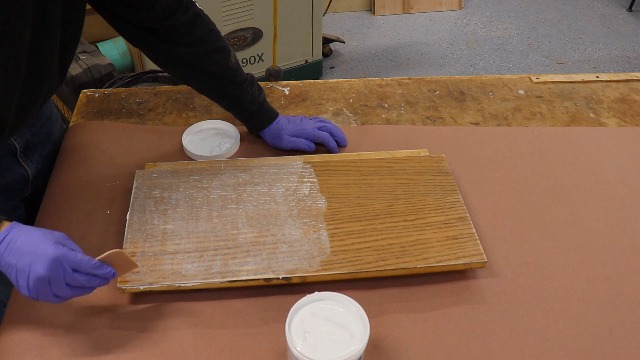
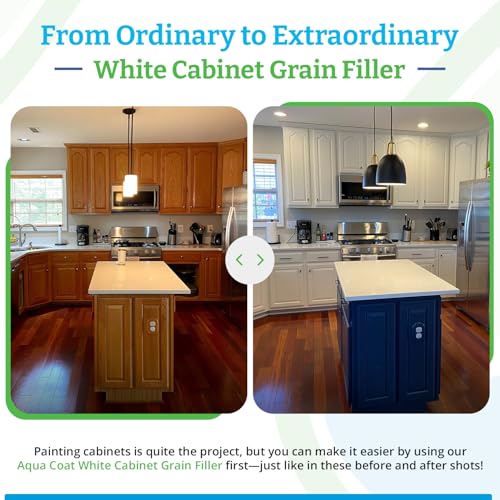
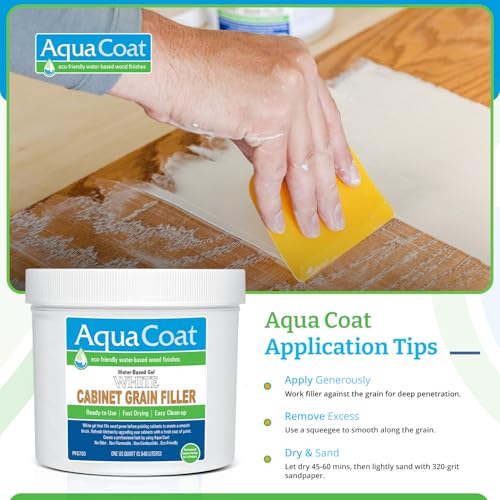
Initially, I made the mistake of ordering their clear gel version of this product, and attempting to put it on top of a coat of BIN primer. It instantly yellowed and cracked. Avoid the clear gel unless your topcoat will also be clear; it uses a different chemical formulation and isn't as effective as the white product. If you are painting old oak cabinets white, this is the grain filler to use. See my picture for a result of what my cabinets look like after three very fine coats. Here is my advice to getting a perfect result: 1. Apply using a spreader--Amazon recommended the Dynatron 358 Spreader 3-pack from 3M and they are fantastic and absolutely essential for proper application. The flexibility of the spreader and fine edge makes it easy to "push" the grain filler into the recesses of the grain, and using the long spreader it is very easy to scrape off the excess leaving a perfectly flat finish. 2. Apply VERY THIN COATS. You're only trying to fill the voids, nothing more. Aqua Coat recommends three coats and I've also found that three coats seem to result in an almost perfectly flat surface. No, it's not as flat as MDF, but that's why you're still going to want to apply two coats of primer and a high performance white enamel cabinet paint with good leveling characteristics. Do not cheap out on your topcoat! These are cabinets, and they demand a high quality topcoat like General Finishes Pigmented Poly in White (if spraying), or their Brushable White Enamel (if brushing). Spraying is always preferred. 3. Between coats, hit it with a 3M scotch-brite pad (I use the purple "very fine" variety) to remove the dust nibs and scuff the surface enough for the next application. Literally a quick pass is all it takes. Then, remove the dust you just made with compressed air or a damp rag. Compressed air is better as you don't have to wait for it to dry. You don't want to apply this product to any damp surface. 4. When you're using the spreader, initially apply the gel perpendicular to the grain, to "push" the material into the grain. On your finishing pass, use the longest spreader possible and go with the grain. This will ensure your spreader is riding on the highest material and you'll get the best results. 5. If you see cracking once dried, it means you applied too much. I had some very minor cracking in the corners where the cabinet center panel met the rails and stiles. It's tough to really fish out all that build-up, but I didn't stress about it because I will be running a thin bead of caulk around the entire center panel. This is a best practice when painting previously stained cabinets. White is incredibly unforgiving and you'll notice every tiny gap if you don't caulk ahead of time. 6. Your time is valuable. Don't waste it by grain filling the back of the cabinet. Focus on the front, and where the grain runs the deepest. I didn't even worry about the rails and stiles because I observed the solid oak in those areas to be quite flat already. Plan ahead of time for how many coats of primer and paint, and do a test to see just how well your grain is hidden. You might discover you don't even need to grain fill certain parts of your project. 7. Those who are complaining about how small this tub is... Again, you are only filling the voids and most of the material you are scraping off and putting back in the tub. I ended up doing 35 cabinet doors and only used half a quart. If you have additional questions, call the U.S. manufacturer at the number on the back of the can. A human being quickly answered and was able to give me plenty of pointers.
S**V
Worked well filling in grain in oak cabinets.
This is a really good product. I was skeptical that it would fill in the deep wood grain in our oak cabinets, but it worked great. Some areas required a second coat after sanding, but the grain is no longer visible. Used one coat of primer and two coats of paint to finish. We also purchased new cabinet doors and the cabinets look like new!
J**S
Mix It With Wood Filler For Best Results
By itself, this stuff is good, but not great. It has a creamy pastey texture that dries like paint and fills tiny wood grain crevices really well. However, it shrinks down when it dries. What you end up with is a coat that's not level. It requires multiple coats (up to 6 on oak board) and a lot of sanding to get it level. That's a lot of work for a product that's so pricey. Pro Tip: Mix 1:1 with wood filler like DAP's wood plastic. This gives you the best of both worlds. The Aqua Coat helps the mix go on smooth, fills tiny gaps, and keeps the wood filler moist so it's easier to work with longer. The wood filler doesn't start to crumble like it would by itself. The wood filler gives volume to the mix and resists shrinking. Also, the wood filler is much cheaper and allows the Aqua Coat go further so you don't have to buy as much and you save money. What takes 3 or more coats now only takes 1 or 2.
M**J
Excellent grain coverage!
My first use of this product ... used it to prep an old oak furniture piece for painting. Completely eliminated the grain! At first I thought its consistency is a little strange, but it applies very smoothely. Dries quickly and sands perfectly. A little pricey, but a little bit goes a long way ... I expect to complete many projects before needing to buy more.
J**.
Really works well to fill in the wood grains
This stuff really works well to fill in the grains. I used on old oak cabinets. Looks nice and smooth now. Easy to use. Low odor and dries quickly.
M**D
Grain filler
Works ok. Tends to shrink alot.
W**0
Perfect for oak cabinet faces
If you're applying to let's say oak cabinet faces and you want to get it near grainless and smooth. I wouldn't apply until you have used minimum 220 grit finish paper or you will sand most of it off and the grain want take good. Then maybe hit it light by hand with 220 or greater and you should only have to do a couple few lite swipes and best to use a sponge or block to stay flat. Never leave any windrows or anything on edges obviously. This does have blending capabilities for small tappers where uneven cabinet faces that you did the best to reset or blend out sanding can be blending even better with this product and adhere and hold. This was second coat and really could be done, as great primers will hide enough for some. If you ordered new cabinet doors and drawer faces that are paint grade maple this will match better and won't be able to tell what kind of wood species near as much. Use a hard rrubber applicator more like when applying glazing putty over Bondo to fill pin holes in auto body repair bit can never use on edges or the applicator is done or will need to sand edge back on applicator itself. Plastic applicator for pushing out bubbles installing tinted windows work great also. Harder wreck edge on this applicator. Most likely areas will need second coat with super light sandings in between. There have been reviews as to if this actually can 100% fill the grain up and in my opinion, not quite. Depending on the grain it will fill near up between 1 and 4 coats. Some grain just won't take material. You could try sanding in the 300 grits and more coats but my gosh, there older airless spray painted cabinets. Very nice, but not that nice. Still a five-star for what you're getting in the absolute ease of product and it's adhesion properties. All day long son.
C**L
The paste to fill in the wood grain works great but one must follow the instructions on the label. The shrinkage is evident but after 3 applications the grain has disappeared. Sanding in between coats is important and one must follow the grain.
N**S
The product dries quickly and is very hard. Little or no shrinkage. Very good, however, very expensive.
M**N
Product was as expected
P**G
Very good product, you have to use 2 coats minimum, but it covers very well
R**D
Product exactly as described. Used in old oak kitchen cabinets. Not finished yet but so far everything going as expected. Easy to work with. One thing. Do not over apply. Once hardened it’s very hard. Light coats are better
Trustpilot
2 weeks ago
2 weeks ago