Desert Online General Trading LLC
Dubai, United Arab Emirates
Desert Online General Trading LLC
Dubai, United Arab Emirates

Full description not available

E**T
Excellent accessible cultural analysis - A must-read!
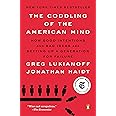
What is happening on the college campus? Is it really as bad as the news stories report? What can be done about it? Jonathan Haidt and Greg Lukianoff have put together a book to help. The title is long enough to make a puritan blush, but it certainly sums up the message of the book: good intentions and bad ideas can do a lot of damage. The book was born out of a 2015 article written for the Atlantic by the same title (You can read it here). This is the second book by Jonathan Haidt I have reviewed. The Righteous Mind here. This book is not a screed against the “kids today” and how we just need to get back to the good old days. Haidt is a moral psychologist who works as a professor at NYU. Lukianoff is the president of FIRE (Foundation for Individual Rights in Education) which focuses on defending First Amendment rights in higher education. Both men independently noticed some disturbing trends which led them to co-author their initial article. Afterward, they decided to put their research into a book to delve deeper into the problem and offer solutions. The book is divided into four parts:Part 1: Three Bad IdeasThe authors explore three key bad ideas which seem to be accepted more and more in society:1) Kids are incredibly fragile.2) We should always trust our feelings.3) Life is a battle between good and evil people.These ideas are bad because they are false. First, children are anti-fragile. They are not like glass which shatters. Rather they are more like a muscle that gets stronger when tested. This is not to say trauma is acceptable any more than we would say an athlete getting injured is getting stronger. The point is that kids are stronger than we think.Second, the problem with always trusting our emotions is that we can be easily fooled. We lose the ability to have a healthy confrontation because we stop caring about someone’s intent and only care about their impact on our emotional state.Third, when we boil relationships down to only a conflict between good and evil people we will not be open to compromise or even listening to the other side. If I think my opponent is basically Hitler then I am not going to reason or persuade him. I am going to fight him.These three key ideas are being taught and reinforced in our education system, entertainment, and social media. The problem with these ideas is not the intent behind them which is protection and the betterment of society. The problem is that these ideas in action make everything worse and actually do the opposite of what they intend: we become more fragile, more angry, more stressed and anxious and so on.Part 2: Bad Ideas in ActionThis section catalogs cases where these bad ideas were put into play. The authors are careful to note that events are not indicative of every college campus. However, they are present in major universities predominantly on the west and east coasts. The authors review some of the riots that occurred in recent years on college campuses as well as the march in Charlottesville. They examine the nature of intimidation and violence that is trending in the news. Then they look at why our society is so prone to witch hunts and the importance of viewpoint diversity.Part 3: How Did We Get Here?This section was the most emotionally difficult part of the book for me. The authors dissect how we arrived in this situation focusing upon polarization, anxiety and depression, the decline of play, the rise of safety policies, and the quest for justice. They examine the influences of social media, screens, overprotection, and misguided efforts to achieve social justice. This section is not blasting those who want justice, school administrators, parents or children. The authors are interpreting the data in terms of “six threads” that together help explain how it is we arrived in our present state.Part 4: Wising UpAgain, the book is not just old men yelling to protect their lawns. The authors present solutions along three lines: families, universities and society. They encourage parents to allow their kids to take calculated risks while resisting the urge to jump in as soon as they struggle. The authors talk about teaching children how to cope with disappointment and pain. They strongly recommend limiting screen time. There are more solutions, but if you want to know them you should read the book!REFLECTIONSThis book came out at the right time for me as I had just finished reading Haidt’s The Righteous Mind. I also watched the news and was actively wrestling with my own use of social media. Normally it takes me less than five minutes to fall asleep at night (apparently I’m overtired). Yet there was one-night last spring (2018) that I couldn’t go to sleep because I was so angry about things someone I didn’t know said on social media. My mind wouldn’t rest as I rolled over what my response would be to this person and how I would show them how wrong they were. I think it was around 1:00 am that I finalized my brilliant rhetorical salvo I would unleash in the morning. However, when I woke up I knew something was wrong with me. I needed to back off social media. Last fall I even deactivated my Facebook account. I didn’t even self-righteously announce it beforehand! The point is that I was primed to read this book.This book thoughtfully and fairly engages with serious issues in our society which will get worse unless we commit to making serious changes. I appreciate the authors’ desire not to castigate or vilify anyone. They want to make things better. They assume that the people involved in these issues on the campus are acting in good faith. This allows for thoughtful analysis and generous criticism that actually contributes to the conversation. My only criticism is that the final three chapters which present solutions are very short. Perhaps in time, the authors can present how they and some of the groups they point to as good examples are handling these modern challenges. Also, this book cannot give us the reason why we ought to live this way except for the general improvement of society. For Christians, grace and holiness are central for how we interact with others (or at least they should be!). There are core reasons why we are compelled as followers of Christ to live differently than society. As a holy people (set apart by mercy) we do not participate in that which is abhorrent to God. But as people who have been saved by grace, we explain our hope and commitment to Jesus with gentleness, respect, and love. This is not really a criticism. It is an acknowledgment of the limits of a non-Christian book.I was challenged by this book to consider how I am raising my children particularly in terms of allowing them to take risks and giving them the room to fail. This book also led me to reflect on how I interact with others. I found myself reading this book saying, “Yeah, the Bible says we should do that…” We know it yet we don’t do it. For example: thinking the best of others or at least giving them the benefit of the doubt. Or how about not be hasty with our words in person and especially online? I seem to remember something about taking every thought captive. A good sign to me that this is a good book is that you leave it hopeful that we can do better or at least how I can do better.THE BOTTOM LINEI said in my review of The Righteous Mind that I would likely recommend this book over that one. That turned out to be true. This book does a wonderful job explaining current trends and what can be done about them. Positively there seem to be reasons for hope that things are changing already on the college campus. While this is encouraging, the pressure to unnecessarily self-censor seems to be increasing and there remains a cause for concern. This book is well written, engaging and challenging. It is not a Christian book (I'ma pastor) so don’t expect biblical answers or a biblical worldview. I do recommend this book if you are looking for an insightful cultural analysis of the rise of terms like “trigger warning” and “safe space” and the current state of social discourse in America. Overall, an excellent read and well worth your time.
G**D
A book every every civic-minded American should read
“This is a book about wisdom and its opposite,” write Greg Lukianoff and Jonathan Haidt in The Coddling of the American Mind. “It is a book about three psychological principles and about what happens to young people when parents and educators—acting with the best of intentions—implement policies that are inconsistent with those principles.” In my opinion, it is also a book every American concerned with the future of our nation’s public discourse and democratic culture should read.And yes, I am serious about that.The Coddling of the American Mind grew out of the increased support among college students for censorship of controversial opinions, a trend that Lukianoff began to notice in the fall of 2013. Lukianoff is president and CEO of the Foundation for Individual Rights in Education (FIRE), a leading advocate for free speech on college and university campuses. In his experience, until that time, the leading advocates for censorship had been college administrators. What was driving the rapid rise of support for censorship among students?For much of his life, Lukianoff had suffered clinical depression, even contemplating suicide in late 2007. In 2008, he underwent cognitive behavioral therapy (CBT), a form of psychotherapy that identifies distorted patterns of thinking that often underlie depression and anxiety, and this helped him tremendously. As Lukianoff interacted with students, he noticed that the way they reasoned about controversial issues often mirrored the same cognitive distortions CBT teaches people to control.This insight led to a conversation with Haidt, a social psychologist, Thomas Cooley Professor of Ethical Leadership at New York University’s Stern School of Business, and author of The Righteous Mind: Why Good People are Divided by Politics and Religion. That conversation led to a feature story in the September 2015 issue of The Atlantic. The book builds out the article’s core thesis.Lukianoff and Haidt unfold their argument in three parts: Part I, “Three Bad Ideas,” looks at “three Great Untruths”:1. The Untruth of Fragility: What Doesn’t Kill You Makes You Weaker2. The Untruth of Emotional Reasoning: Always Trust Your Feelings3. The Untruth of Us Versus Them: Life Is a Battled Between Good People and Evil PeopleTaken together, these untruths result in “a culture of safetyism” on campus, whereby students must be protected from opposing opinions that might “harm” their “safety,” no longer defined as physical safety but now as emotional safety too.The results of this culture of safetyism, ironically enough, are intimidation and violence on the one hand and witch hunts on the other, as the Lukianoff and Haidt argue in Part II, “Bad Ideas in Action.”They cite the February 1, 2017, anti-Milo Yiannopoulos riot at the University of California at Berkeley as an example of the former, though there are many such examples scattered throughout the book. But the threats of violence are not merely coming from leftwing Antifa activists on campus. The authors point to alt-right off-campus provocation as well, specifically the neo-Nazi march through the University of Virginia’s campus on August 11, 2017. The confrontation between protesters and counterprotesters the next day resulted in the vehicular murder of Heather Heyer by an alt-right driver.Lukianoff and Haidt cite several examples of academic witch hunts conducted against professors who utter heterodox ideas, even if they are liberal or leftwing. Prof. Bret Weinstein’s protest of the “Day of Absence” at Evergreen State College in Washington is a leading example of this. The school is quite liberal, as is Weinstein. On its annual Day of Absence, minority faculty students had since the 1970s gone off campus to make their absence, and hence contributions, palpable. But in 2017, organizers of the event asked white faculty and students not to show up. Weinstein thought this went too far and was subjected to vicious protests for saying so.As these events illustrate, college and university campuses, which are supposed to be beacons of free speech, have instead in many cases become their opposite. There is no one-size-fits-all explanation for why this has happened, but in Part III, “How Did We Get Here?,” Lukianoff and Haidt identify “six interacting explanatory threads”:rising political polarization and cross-part animosity; rising levels of teen anxiety and depression; changes in parenting practices; the decline of free play; the growth of campus bureaucracy; and a rising passion for justice in response to major national events, combined with changing ideas about what justice requires.This may be the most interesting part of the book, rich in social scientific detail and fair-minded in its analysis. As the parent of three elementary-age children, the chapters on “Paranoid Parenting” and “The Decline of Free Play” were thought-provoking and helpful.Part IV, “Wising Up,” builds on the analysis of the previous chapters and suggests a way forward for making “Wiser Kids,” “Wiser Universities,” and “Wiser Societies,” as the titles of the three chapters indicate. A table on page 263 summarizes the argument of the entire book, so I’ll reproduce it here:PSYCHOLOGICAL PRINCIPLE // WISDOM // GREAT UNTRUTH1. Young people are antifragile. // Prepare the child for the road, not the road for the child. // What doesn’t kill you makes you weaker.2. We are all prone to emotional reasoning and the confirmation bias. // Your worst enemy cannot harm you as much as your own thoughts, unguarded. But once mastered, no one can help you as much, not even your father or your mother. // Always trust your feelings.3. We are all prone to dichotomous thinking and tribalism. // The line dividing good and evil cuts through the heart of every human being. // Life is battle between good people and evil people.As I mentioned at the outset of this review, I am serious when I say that every American concerned with the future of our nation’s public discourse and democratic culture should read The Coddling of the American Mind. It stimulated my thinking as a parent and helped form a better opinion of contemporary events as a concerned citizen. As a person, it provided an accessible introduction to cognitive behavioral therapy, identifying the cognitive distortions that misshape our opinions and hence misguide our actions. And as a politically conservative Christian, it reminded me that there are non-religious liberals (e.g., Lukianoff) and centrists (e.g., Haidt) who are intelligent and public-minded and have things to say I need to hear.So, buy this book. Read it. Then share it.
L**Z
Must read- but Anxious Generation was better
I liked the Anxious Generation better but this was pre- AG. Lots of useful information and tips for parents
Trustpilot
1 month ago
1 week ago