

Desert Online General Trading LLC
Dubai, United Arab Emirates
Desert Online General Trading LLC
Dubai, United Arab Emirates
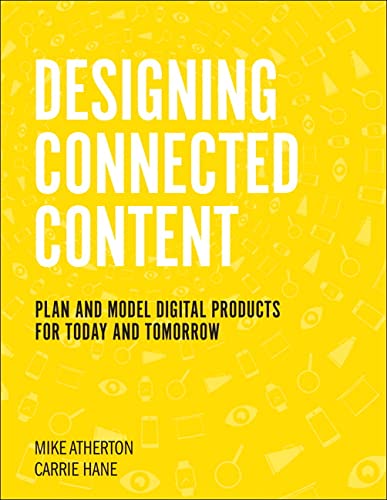
Designing Connected Content: Plan and Model Digital Products for Today and Tomorrow
J**E
The must read for Information Architecture
Designing Connected Content is a must read for Information Architecture. I read and enjoyed the ‘polar bear’ book, which is the defacto book for IA, but the penny really dropped when reading Mike’s book. DCC distils all the principles of IA in an easy to read, enjoyable and enlightening book on how to approach any digital project that has content which needs to be structured and organised. The step-by-step logical approach in designing Domain Diagrams with reusable ‘Domain Objects’ and then refining and enhancing these diagrams as Content Models with ‘instances’ (specific attributes of each object) – is so well explained and illustrated that it makes easy work of creating elegantly simple diagrams that communicate so much information to design teams, database designers and developers. Linking each object or instance with camel case relationships easily transfers to other documentation for database and developers. Everything is well thought out, precisely structured, easy to follow and creates a strong foundation to build future-proof digital services. If you follow this approach you know you have the appropriate structure for any website, app – and content that can feed Alexa and devices that haven’t been invented yet. The short time it takes to read this book will save you many hours of pain and frustration for all the digital projects you produce from now on.
S**R
Now one of my top recommended UX books. Must read!
Literally 25% of the book is highlighted, with things like “YUSSS FINALLLY” written in the margins. Never have I read a book so closely aligned with my way of working and with the content that I teach (object-oriented UX). It's so spot on about the importance of understanding the domain and how object connect in the context of that domain. As the authors write, “Design starts from sharing a common language.” And this book is a manual for creating that shared language, the scaffolding for any strong UX. If you want to create products that are more future-proof and intuitive, you have to read this book. Great job, Carrie and Mike! And if you are reading this review, wondering whether this book will really improve your designs and your design process—stop wondering. Yes. Yes, it will.
J**L
Content matters--so design it with intention.
It's amazing how often software projects spend millions of dollars and address the content in the project only at the end of the process. It's also amazing how often UX designers (who should know better) forget that content design is core to the user experience. And too often product managers say, "Oh, we'll pour the content in later."Fortunately, Mike Atherton and Carrie Hane have written a wonderful book that weaves its way from the smallest element of content to the holistic experience that content brings. With wit and wisdom, Atherton and Hane clear a lot of misconceptions about content, showing how to structure content so that it is maintainable, elastic, and targeted.I love how they talk about researching existing content, deciding how to model it, and strategizing on where to put it. Chapter 8, "Implementing Connected Content," spoke to me specifically around a project I'm working on. Intranets especially can be improved by thinking about structuring content, and the project I'm on now is being improved just because I have thought differently about the work I'm doing...thanks to Designing Connected Content.I've attended talks that each and both have given over the years, and I've always hoped there'd be a book to codify their thoughts. Glad to see it's here!If I had to quibble, it'd be about some book design decisions: The orange chapter separators look nice, but the lack of contrast means it's hard to read the white type on that orange. Orange you wishing you'd chosen a different color, New Riders?That being said, I've been waiting for this book for some time. While other great books recently have talked about content strategy (viz. Bloomstein, Halverson, Jones, Wachter-Boettcher), this one seems more practical for my purposes. YMMV, but I'd highly recommend it.
A**D
Structured content is the future – and this is a complete toolkit to get you there
Let me start by seconding everything in the previous reviews. If you want to know more of what this book is about and where you can apply it, check them out. I want to add that to my eye Connected Content is in the same phase of emergence now as Responsive Web Design was circa 2012/2013. I've worked with lots of clients who know that the way their content is stored and served up sucks, but don't really know what to make of structured or connected content (and are probably silently hoping it will just go away). Mike and Carrie will help you make a case to these folks that connected content is not going anywhere and that if content publishers want to continue to stay relevant (and in control of what they publish), they're going to have to pay more attention to how their content is put together, as opposed to simply how it looks on the page.This book will also give you the tools to plan, execute, and deliver connected content to your client or organization. You'll see several themes that come up in similarly brilliant work by Sara Wachter-Boettcher and Karen McGrane, as well as new ways of putting them all together and examples aplenty of where they occur out in the world. But most importantly – like Ethan Marcotte's seminal book on responsive web design – this book gives you the tools and a structured process to design and build structured and connected content solutions in context. Like any process, you'll have to adapt it to your situation, but you'll be starting with a full toolbox.I suspect content strategy is still getting a seat at the table (or is simply still a mystery) in many organizations. This is not a book just for content strategists. If you're in charge of (or responsible for ... or blamed for) organizing, structuring, and disseminating digital content, this book's for you.
S**Z
Best book ever? At least when it comes to content modeling!
My colleagues and I have dubbed this "the best book ever" thanks to the clarity it brings to the loaded practice of content modeling. By starting with a model of the subject area (domain), the approach in this book grounds the model in "truth", giving it the most stable foundation possible. Content types, their attributes, and their relationships derive from this reality. Then, once you solidly understand these "building blocks", you can mix and match them in any user-facing representation that you want. I love it!I recommend this book for anyone who:- Doesn't know where to start with content modeling- Wants a beginning-to-end process for designing and delivering content that can withstand future technology innovations- Wants to base their model off of more than existing content. This seems like a more resilient way.- Has tried content modeling before and failed- Finds it difficult to make decisions and plans because content structure, sourcing, delivery, and design are too tangled together. This book divides complex content problems into manageable, bounded conversations.- Needs a way to drive alignment among their content stakeholders- Believes good content architecture requires good understanding of the subject domainI can go on. Really, all content strategists should read this book.
Trustpilot
1 week ago
3 days ago

![Content Strategy for the Web [paperback] Kristina Halvorson,Melissa Rach,Sarah Cancilla [Jan 01, 2012]…](https://images-eu.ssl-images-amazon.com/images/I/81TWmE+xFjL._AC_UL116_SR116,116_.jpg)